Kisses from the Sun

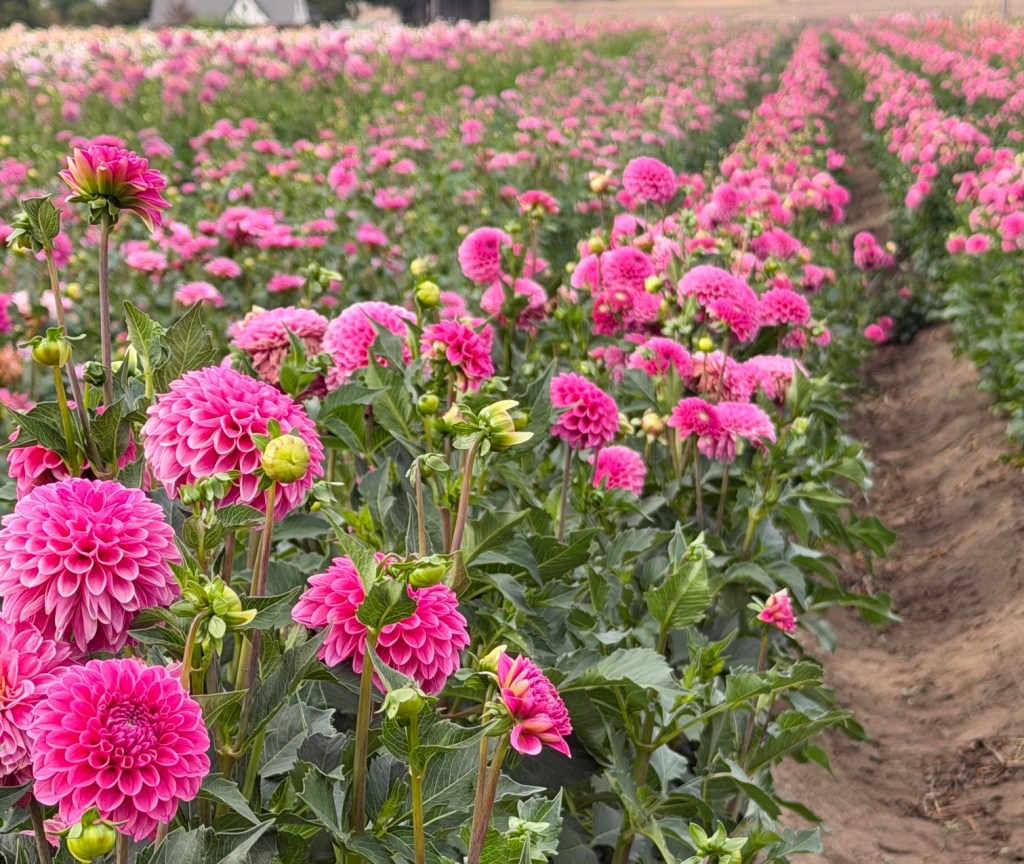
In late August I visited Swan Island Dahlias, “the largest and leading dahlia farm in the United States,” where I wandered through more than 50 acres of an astonishing variety of dahlias in full bloom.  We stopped at one point to chat with two women from Europe, sharing our awe at the display.  As they turned to leave I noticed the following saying on the back of one of the women’s t-shirt:

Les fleurs sont des baisers du soleil,
déposés sur la terre avec amour

which translates as

Flowers are kisses from the sun,
placed upon the earth with love

I have never since looked at a flower without thinking “kisses from the sun,” and feeling gratitude for my place in creation.

◊

In my personal faith, and in my work as a chaplain, I try to maintain a balance between a science-based mindset and mindfulness of all of the mysteries that science cannot address.  Take, as one small example, flowers.

I understand, at a layperson’s level, how flowering plants evolved in prehistoric times to become the most diverse and dominant plant form on earth.  They are the source of almost all plant-based food that we humans and most other large animals consume.  They are the certified winners in the evolutionary processes governing plant life on earth.

I also understand, again at a layperson’s level, why flowers appear attractive to many animals.  To wander through a garden in full bloom is to be surrounded by honeybees, hummingbirds, and other animals who derive their sustenance from flowers while also fulfilling the flowers’ need for pollination.
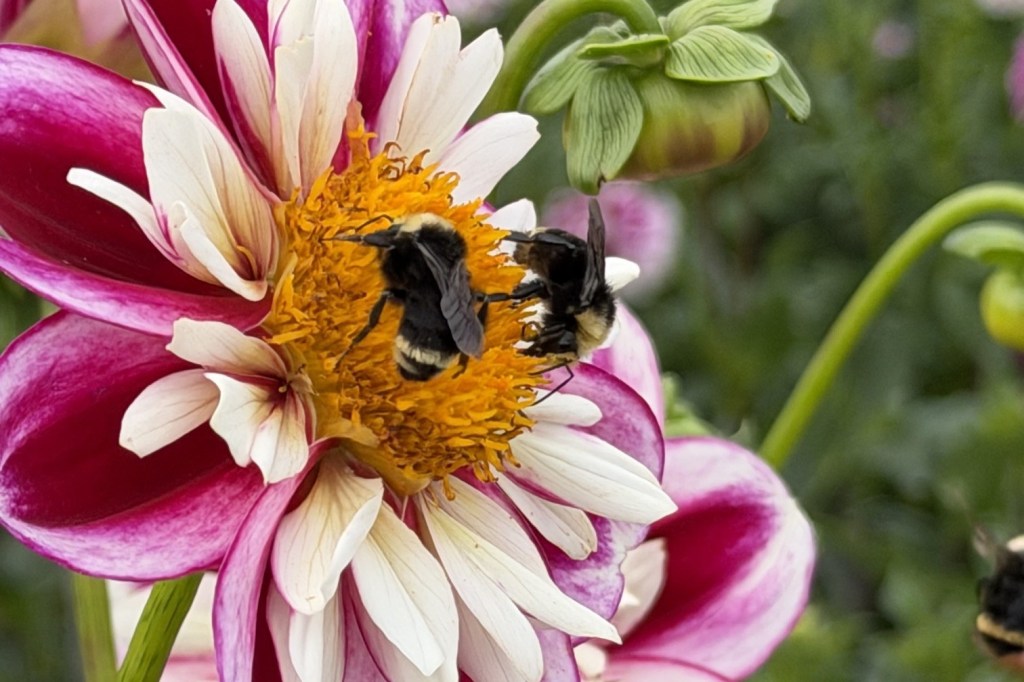
Less obvious to me is why we humans are touched so deeply by being in the presence of flowers. People began cultivating ornamental gardens at least 4,000 years ago, simply to surround themselves with beauty. When I gaze at fields of lupine and paintbrush in the mountains, or acres of cultivated dahlias, or even just a single blossom, I am filled with awe for which I find no words. My scientific mindset does nothing to explain this feeling.

“Kisses from the sun, placed upon the earth with love” is a more satisfying explanation for me.  Of course, this begs the question of who is doing the kissing and placing, and that is a matter for theology.  For myself, I long ago surrendered to the notion that my very existence, and the universe I exist within, are the consequence of a creative impulse of a being / force / entity far beyond my understanding.  When I reflect on my existence in that universe, I feel beloved.

In my Christian faith I immerse myself in a set of narratives that makes these ideas more tangible and actionable for me, and in a community of others who do the same.  But the experience of wonder and belovedness expressed in “kisses from the sun, placed upon the earth with love” extends far beyond that community.  It knows no boundaries of religion, geography, or culture.

As a chaplain, I am asked by people of different faiths and of no expressed faith to offer a prayer for them, even if they often cannot articulate what prayer means for them.  I usually begin, “Dear loving creator [God], thank you for the gift of your child _____,” to help them see themselves as a wonderful creation that is worthy of love—and beloved.  I believe we have all have been placed upon the earth with love, and are deserving of the kisses all around us—including flowers.

Women on the Verge

Making rounds one morning, a nurse suggested I look in on Viola, age 74, who was having a procedure later that morning.  I reviewed her chart and saw that she’d appreciated visits from chaplains in the past.  I also saw that tests completed the day before had revealed advanced metastatic cancer.

Her room is dimly lit but she is sitting up in bed.  As I knock and enter, I see her eyes are closed. 

“Good morning, Viola, it’s Chaplain Greg,” I say softly.  “I know you have a procedure later this morning, so let me know if this isn’t a good time for you.”

“No, you’re right on time, Chaplain.  I’m just lying here praying.”

“What’s on your heart this morning?  I know you got some difficult news.”

Viola nods.  “I’ve been listening to the Lord, and the Lord’s telling me that He’s got this, just like always.  He’s telling me that there’s no work for me to do here, that it’s all in His hands, and all I need to do is relax and enjoy the ride.  So that’s what I’m focusing on doing.”

“Isn’t it wonderful,” I ask, “the ways God shows up for us in times of need?”

“You got that right, Chaplain.  I have been so blessed all my life, and I know I will continue to be blessed.”

We share a lovely time of prayer together, filled with gratitude for God’s presence and caring, and for the light God brings into our lives.

“Thank you, Chaplain,” Viola closes.  “Now you go carry some of that light to the rooms of other patients you see.  Thank you for the work you do.”

“And I thank you, Viola, for the gift of your prayers.  They give me the strength to keep doing this work.”

◊

It is always a gift to me to be in the presence of bedrock faith, something I often find in black women of a certain age, like Viola (or Aunt Julia).  Their faith has withstood crises and losses the likes of which I have never known.  It gives me hope that my own faith will carry me through the losses that undoubtedly lie ahead—that with faith, all things are possible, even if it’s a mystery as to how this is so.

◊

The next day I visit Maggie, age 88, who had learned two days before of the spread of long-dormant cancer.  Dressed in street clothes, she is trim and fit and looks at least 10 years younger than her chart indicates.  She’s on her phone but waves me in.

“I’m discharging soon—my son’s on his way—but I need to make sure my pharmacy has my prescriptions straight,” she says in a tone that is all business.

She soon hangs up, then looks at me.  “Are you here to say a prayer?”

“I certainly can, if that’s what you’d like.  What would you like me to know about your faith?”

“I’m an active Christian, raised Catholic but I’ve spent most of my life in non-denominational churches.  I’ve led music in many of them.”  She continues in the same matter-of-fact tone.

“And how is your faith showing up for you today?”

A long silence, then, “I don’t know.  I’m so confused.  I’ve had lower back pain for a long time, which I chalked up to aging.  But it got so bad I came to the ER, and now they tell me I have cancer in my bones and all over, and it’s not treatable.  I just didn’t see this coming.  I don’t feel at all prepared.”

“That’s really hard, Maggie.”  I extend my hand and she takes it.  “Shall we sit in silence for a moment?”  She nods, then begins to cry—weeping quietly at first, then with heaving sobs.

“This is the first time I’ve allowed myself to cry since I got the news,” she shares, as her sobs subside. 

“I think tears can be one of God’s ways to make us stop and pay attention, and to remind us of His presence.”

“That’s helpful.  I do feel God’s presence, I just hadn’t taken the time to notice …”

“So, is now a good time for that prayer?”  Maggie smiles, nods, and we join together in prayer.

◊

While charting my visit with Maggie I receive another request from the oncology floor.  Once again, it’s for a woman, Donna, whose condition has just been declared terminal.  I finish my note on Maggie and take a short walk to gather myself, then I knock on Donna’s door.

Donna is bald and a bit bloated, not unusual for someone who has been undergoing chemotherapy.  She thanks me for coming but then turns away.

“They told me the chemo I’ve been on, which was my last hope, isn’t working and there’s nothing more they can do for my cancer.  I’ve been praying so hard, and lots of people at my church have been praying, too.  My pastor and everyone is calling and texting and I don’t want to talk to any of them.”

“Does it feel like God has let you down?”

Donna nods and begins crying.  “Yes, that’s it exactly.”  We sit in silence for a minute, then she continues.  “Actually, no, that’s not how I feel.  I know God is here for me.  I’ve been through so much already, and God has never left my side.  I guess what I’m really feeling is that I let the people praying for me down.  I don’t want them to lose their faith in God because their prayers didn’t work.”

“Is that how you think prayer works?”

“Well … no.  I’ve known that I would come to this point eventually.  We all do, no one lives forever.  It’s just a shock to realize that I’m now at that point.”

“I think it’s probably shocking for everyone, no matter how strong their faith is.  It’s just really hard being human.”  She nods, and we sit quietly for a moment.

“As we’re talking, though, it occurs to me that you have a chance to show people what true faith looks like by letting them see how your faith supports you now, at this most difficult time.”

Donna brightens at this thought.  “Yes, it’s better for them to see how God really works.  I can do this.”

◊

In the span of just two days, I encountered these three women on the verge of life’s final chapter, each having just crossed the threshold from hoping for a cure to surrendering to mortality.  While their faith manifested in different ways, each had built, through a lifetime of faith, a storehouse of gratitude to see them through the rest of their days.

And, as I shared with Viola, each of these women energizes my own faith, adds to my storehouse of gratitude, and gives me the strength and motivation to keep doing this work.