Safe Passage

A year ago I shared the story Courage and Grace, featuring an inspiring patient named Elyse.  She’d landed back in the hospital with shortness of breath after a four-year remission from breast cancer, and we visited and prayed together as she awaited the results of diagnostic exams. 

During that visit, Elyse told me that her cancer diagnosis was the best thing that ever happened to her, because “the moment I got my diagnosis, I felt this powerful presence within me and outside of me, letting me know that, whatever happened, I was not alone and I’d be safe … and that comforting presence has never left me.” 

Elyse’s story did not end there—I had several more opportunities to visit with Elyse and her family.

Elyse’s husband Keith asked me to join a goals of care conference.  Elyse’s shortness of breath had been caused by a large mass in her chest, and her cancer had metastasized to other places in her body.  As Elyse was still in her 50s, she and her family pursued treatments to extend her life, but none had borne fruit.  Elyse had now drifted out of consciousness, but she’d previously made clear to her family that she was ready to go if it was her time.

We gather and listen as Elyse’s doctors summarize the cascading problems causing her decline, how attempting to treat one will likely make another worse, and the lack of any clear path forward.  She is being kept alive through medications that keep her blood pressure up, and will likely die within minutes if they are withdrawn.  Keith lifts his head and speaks:  “Time to let her move on to her eternal reward.”  

Keith then turns to me and asks, “Pastor, would you join us in Elyse’s room and offer prayer as we say our goodbyes?  I know your presence would be a comfort to her—and to us all.”

As we enter Elyse’s ICU room, her favorite Pentecostal praise singer is streaming loudly from an iPhone near her bed.  Keith, their two daughters, their husbands, and Keith’s brother surround her bed.  They take turns expressing their love for her and praising God for the gift of her life and for His everlasting love.  At their request, I read the 23rd Psalm and offer my own prayers in a manner aligned with their faith and concerns.

The music and prayers continue, mixed with tears and sobbing, as we watch Elyse’s blood pressure and heart rate fall to zero.  There are hugs all around, accompanied by expressions of joy that she is now in God’s arms, and how wonderful it will be to join her one day.

One’s beliefs need not align with those of Elyse and her family, or hold any religious beliefs at all, to recognize this as a “good death”:  accompanied through life’s final passage by the people most important to you, who respect and honor your wishes for end-of-life care, and stand by you to the end.

The 23rd Psalm is one of the most commonly recited texts in Judeo-Christian traditions, for good reason.  For me, the heart of the psalm is verse 4:

Even though I walk through the valley of the shadow of death,
I will fear no evil, for you are with me.

The “you” the psalmist refers to is “The Lord [who] is my shepherd”; for many, including Elyse, this image of divine protection is powerful, but for others it feels remote or meaningless.  To my mind, though, each of us has the ability to bring comfort and safety when someone we know has entered their “walk through the valley of the shadow of death.”  In my experience, accompanying those we love through this valley is a powerful antidote to the fear and anxiousness surrounding the mystery of death.

Many, though, find this accompaniment difficult.  Some friends of my father declined to visit him in his nursing home, saying “I’d rather remember Jack as he was,” and I have spoken with patients many times about loved ones who keep putting off visits.  On one level I find this understandable—seeing someone who was once vibrant but is now frail can be a painful reminder of our own vulnerability and mortality.  But it is also tragic—the one who is dying is denied the comfort that loved ones can bring, and the loved ones who keep a distance deny themselves of one of life’s most meaningful experiences.

This isn’t “chaplain work”—it’s for everyone, at every stage in life.  I recently shared time with a 10-year-old boy and his father as they visited the boy’s grandmother in the ICU, and I marveled at how natural the interactions among the three of them were despite the setting and circumstances.  The boy brought joyous smiles to her face, and he was absorbing valuable lessons about aging and dying.

Even with repeat experience, though, it never stops being hard.  Accompanying Elyse and her family was definitely hard, and it’s harder yet with the people who mean the most to us.  Still, I always feel a bit more completely human every time I show up for someone—and a bit more prepared for my own inevitable passage through the valley of the shadow of death.

Leaving Home

I knocked on the door and was welcomed in by Mike, a man in his 70s who’d been hospitalized with a lung infection.  I’d had a good previous visit with him, and I’d noticed in his chart that he was making sufficient progress that he would soon be discharged to his home.

“Greetings, Mike,” I begin.

“Greetings, Chaplain,” he replies.  “I’m glad you stopped by—they won’t be keeping me here much longer.”

“So I hear … you look great, much stronger than when I last saw you.  I’m sure it will be nice to be home with your wife, and to sleep in your own bed.”

“Yes, it will …”  Mike’s voice trails off as he turns his gaze toward the window.  His face flushes a bit and his eyelids quiver almost imperceptibly.  I quietly take a seat by his bedside and wait.

“An hour ago I signed off on the sale of our home.  We’ve lived there for 50 years.  It’s where we raised our family, and it’s the only home our children have known.  I know it’s the right step for us, but I’m sitting here feeling the weight of it—that this is finally happening, and there’s no turning back.”

“That’s a huge milestone in life, Mike.  I can understand why your emotions would feel so strong.”

Mike launches into “life review,” sharing stories about he and his wife buying the house, raising their children, and special events they celebrated there.  He also remarks how their house has become too much for them, and how much easier life will feel in their new home in a retirement community.

“With all this, it seems ridiculous for me to get so emotional—we’ve been so fortunate compared to so many others, and we’ll do fine in our new place.”

“Those things can all be true and it can still feel like a big loss,” I offer.

“I suppose more than anything it’s a reminder that most of my life is behind me now. There’s no denying we’re getting older.”

“Also true, hard stuff.  It’s good that you can name it like that.”

At Mike’s request, we close with a time of prayer, celebrating all he had been granted in life thus far, and seeking blessings for all that was yet to come.

When Mike and I spoke many months ago, I had no idea I was about to embark on a similar journey.  My wife and I had spoken from time to time about how we couldn’t stay forever in our beloved house of 41 years, but the timeframe for moving kept shifting.  After all, age 70 seems safely distant at age 60, much less so at age 69.

This spring we agreed we should begin getting familiar with options that might fit with our family priorities and finances.  Quite serendipitously, the first house we looked at—just to get a sense of the neighborhood, we said—we fell in love with and agreed we could imagine our future there.  Just as serendipitously, an unsolicited letter arrived in our mailbox from what turned out to be a perfect buyer.  Before we knew it, we were sprinting to make the purchase and sale happen, and uprooting our lives to a new home 15 miles away. 

Only now is the enormity of what we have done settling in … and the story of Mike has bubbled to the surface.  Many of the feelings and memories Mike experienced that day now stir within me.  I find myself trying to listen to that chaplain’s voice.  It’s one thing to speak such words when playing the disinterested third party, quite something else when it’s first person singular.  I can’t deny the weight of the transition, nor should I try (says the chaplain again).  Getting through this move, and the process of absorbing its meaning, is the reason behind Elder Chaplain’s three month hiatus.

An acquaintance whose work I admire uses the phrase “befriending mortality” to capture the heart of her practice.  This resonates strongly for me, as it captures one of my deepest hopes for my work as a chaplain, and for my writing in Elder Chaplain.  Mortality is like an uninvited guest in one’s house, one that may at first reside unobtrusively but over time becomes increasingly disruptive, and eviction is not an option.  The great Sufi mystic Rumi teaches us to befriend such guests:

Welcome and entertain them all!
Even if they’re a crowd of sorrows,
who violently sweep your house
empty of its furniture,
still, treat each guest honorably.
He may be clearing you out
for some new delight.
[1]

We have now swept our former house empty of its furniture, and we are preparing our new house in hopeful anticipation of new delights.  Mortality made the move to the new house right along with us, and will undoubtedly be a disruptive guest in the future, as it has been in the past.  I’m not ready to say we’re friends, but we are learning each other’s ways and accepting that we’re in it together for the long haul.


[1] The Guest House, by Rumi.

You Are Safe With Me

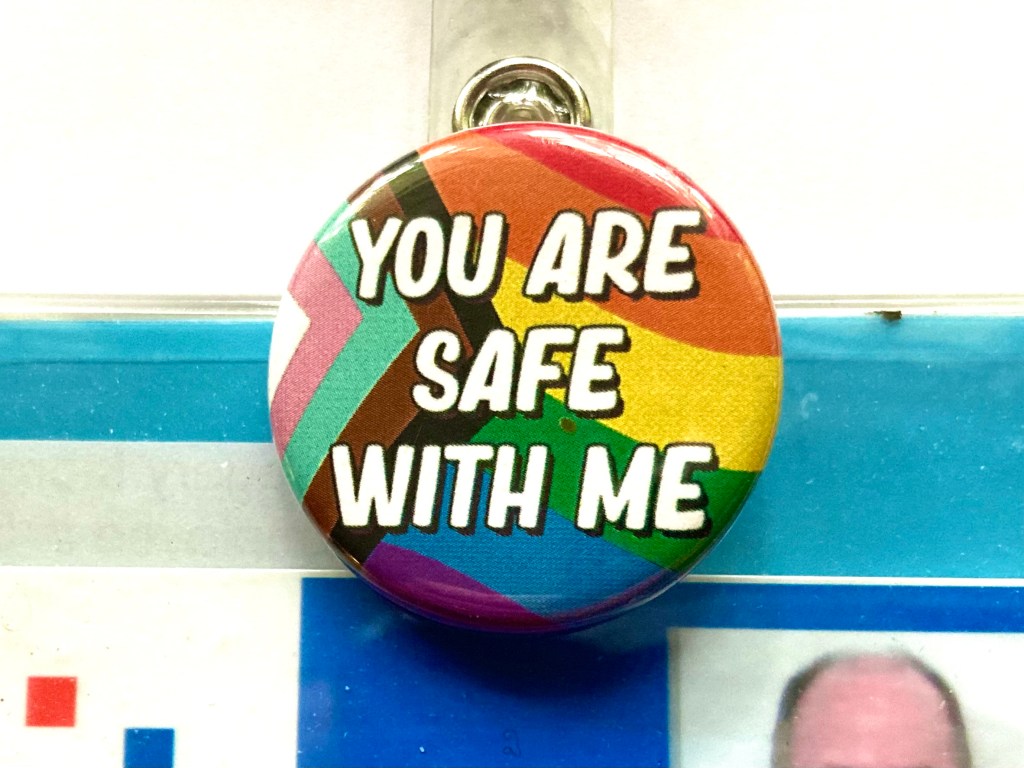
A couple of years ago, during Pride Month, someone at our hospital offered the button pictured above to anyone who wanted one.  I have worn mine on my badge every day since, as “You are safe with me” is an appropriate message in any situation.  Two recent patient encounters drove this home for me.

Evan was a 32-year-old living on the streets, using fentanyl daily.  A wound on his hand became infected; without care that infection grew into an abscess heading up his arm.  Unable to bear the pain any longer, he came to our ER and was admitted for antibiotic treatment and surgery.  When his nurse asked him if he would like to see a chaplain, he said he would.

I entered Evan’s room and found him in a fetal tuck, the sheets pulled over his head.  When I announced myself, he peeled the covers back just enough to eye me, revealing close-cropped rainbow-colored hair.  He motioned for me to sit on the foot of his bed, so I did.  I told Evan I’d be happy to listen to anything he wanted to say, or just sit with him in silence.  He responded, “Silence,” so I closed my eyes and sat silently.  From time to time I looked over to him; often his eyes were closed; sometimes he was observing me, and I tried to offer an affirming smile.

After a few minutes I said, “I am also happy to offer a hand to hold, if that is something you’d like, but it’s completely up to you.”  Quickly a hand slipped out from the covers, still stained from the grime of the street despite a hospital cleansing.  I placed his hand in mine.  His grip was initially limp, but soon he began squeezing gently, and I squeezed in response.

Then Evan spoke.  “I just want to be healed from my addictions.  Will you pray for me?”  I asked, “Is there a religious tradition that is important to you?” and he replied, “Methodist.”  I asked, “Were you raised in that church?” and he nodded yes; I asked, “Was that a good place for you?” and he nodded again; I asked, “Is that someplace you would like to move back toward?” and he nodded a third time.  So I offered prayers using Christian language, giving voice to his pain and longings.

As I shared in my previous post, Not That Kind of Chaplain, one of the central elements of creating a safe space is giving the other person maximum agency to set the terms of the encounter.  For Ingrid, the patient at the center of that story, this was easy.  But patients like Evan generally bring to the encounter a history of trauma, and life on the streets means having no safe spaces.  Any attempt to move the encounter forward more quickly than the other person is comfortable with is likely to backfire.

Maslow’s hierarchy of needs places safety second only to our physiological needs, and under duress it can jump to the top.  Most of us, when meeting a person for the first time, hold our cards close to our chests, opening up only to the degree we perceive the other person to be safe.  My own needs for safety were much on my mind when I entered Evan’s room, and approaching him the way I did served my needs as well as his. I’m grateful that we each found the other to be sufficiently safe for such a meaningful encounter.

Angela, a mother of three and survivor of a suicide attempt a month earlier, was admitted for a terrifying constriction in her windpipe.  After surgical treatment she was healing well.  During my first two visits other family members were present.  Angela projected an upbeat vibe, but always urged me to return. 

On my third visit Angela was alone.  She opened our conversation by saying, “I really like your button.  I noticed it before and wanted to say something.” 

I replied, “I like it too.  One of the most important parts of my job is to make people feel safe to share what’s really on their hearts.”

With that opening, Angela proceeded to speak honestly about her suicide attempt and all that led up to it:  a lifelong struggle with depression, the end of a long-term relationship, losing her home and moving into a trailer, troubles with her kids, a sense of hopelessness, and a bottle of pills too readily available.  But like George Bailey in the movie It’s A Wonderful Life, the people who showed up and cared for Angela through this crisis gave her a renewed appreciation for the value of her life and her importance to so many people.

Then she said, “I feel like I’ve grown distant from God.  I used to go to a Bible church that I liked a lot, but then a new pastor came in saying all kinds of hateful things about people who didn’t believe the same way he did.  That didn’t seem at all like what Jesus was teaching, so I left.  But now I don’t think about the good things Jesus taught any more.  Could you pray for me?”  And so we prayed together.

“You are safe with me” has become an important personal mantra, concisely encapsulating the type of person I want to be in all my relationships.  I still have to tend to my own personal boundaries, of course, and not every person is someone I can feel safe with.  Pursuing this goal has been a journey of personal growth, one that began years ago in my personal and professional life, even if I couldn’t previously name it this way.  Now that I can, it’s something I want to consciously keep getting better at.

Not That Kind of Chaplain

A spiritual care consult order came in from a unit I was covering.  Annie, a nurse on the unit, noted that Ingrid, an elderly woman in her care, seemed lonely and anxious; Annie thought she might benefit from someone to talk to.  Annie is delighted when I arrive and takes me in to see Ingrid.

“Hello, Ingrid!” she announces brightly.  “The chaplain is here to see you.”

“I didn’t ask to see a chaplain,” protests Ingrid.  “Why would I want to see a chaplain?”

“When we talked this morning,” Annie replies, “you agreed it might be helpful to have someone to talk with.  That’s why Chaplain Greg is here.”

“Yes, I did say that, but I didn’t say I wanted to talk to a chaplain.”

“Oh, don’t worry, Ingrid,” Annie smiles.  “He’s not THAT kind of chaplain.  Trust me, you want to talk to our chaplains—they’re the best!”

“If you say so …” Ingrid relents feebly.  Annie executes a quick about-face and heads out the door.

“Greetings, Ingrid,” I begin.  “Annie’s right, I don’t have any agenda, I’m just here to offer you company.  You don’t have to talk to me at all if you don’t want to, it won’t hurt my feelings.  It’s entirely up to you.”

“OK … but I don’t even know where to begin.”

“Well, you’ve clearly lived a long life, and I’m sure you’ve got stories to tell.  What would you like me to know about you?”

“I was born 94 years ago in a small town in Norway, north of the Arctic Circle,” Ingrid begins, and she is off and running with what we call “life review”—including positive memories of her Lutheran upbringing, a faith that fell by the wayside when she married and moved to the U.S.  It was amazing and heartwarming.  Acknowledging that her life is now nearing its end, she accepts this with equanimity and gratitude.

“I realize I’ve talked your ear off,” Ingrid concludes as she begins to fade, “but I do feel much better now.  So this is what you do, listen to people like me?”

“We do many things,” I reply, “but listening is the most important.  If people have religious or spiritual concerns, we are certainly there for that.  Often, though, people just need to talk to someone who really wants to listen.  It can be healing for them, and in return we get to meet wonderful people like you.”

“So now I know.  If that’s what chaplains do, you can come by any time.”

Ingrid’s reluctance to visit with a chaplain was not at all unusual.  I once had a man shout “OUT!” the moment the word “chaplain” left my lips.  More often, people smile nervously and say, “No, thanks, I’m fine” when they sense religion might be on the agenda.  It’s unfortunate, but I can’t say I blame them.

Our children were born almost 40 years ago in a Catholic hospital, with a crucifix displayed prominently in each room.  The care we received was wonderful, but each time before discharge a nun, calling herself a chaplain, came by to perform a blessing on our babies.  She didn’t ask about our beliefs, and her agenda, not the desires of the newly expanded family, was the focus of the encounter.  We told her, “No, thanks, we’re fine.”

I know of many chaplains who struggle in workplaces where the other chaplains celebrate the number of souls they save for Jesus, despite training that emphasizes the need for respecting the faith traditions—including no tradition—of those they serve.  Even worse, a movement has recently emerged to place “volunteer chaplains” with no formal training in schools and other public institutions, with an explicit goal of proselytizing.[1]  No wonder the word “chaplain” sparks trepidation in many who hear it.

I’m happy to say I’m not that kind of chaplain, and neither are my colleagues.  We seek to put the patient (and/or family) and their needs at the center, and let them guide us toward the type of care that will be healing for them.  That begins with helping them feel safe to speak from their heart, without fear of judgment, much less a religious pitch.

Patients who want prayer or other religious care are usually direct about it, and we are always delighted to inquire about their faith and practices and offer care aligned with their preferences.  More often than not, though, the patient’s needs and wants are less obvious, so we try to approach in a way that is open and inviting.  Often, as with Ingrid, a patient may have no issue with religion, it’s just not what they need or want at that time. 

But many patients have a difficult relationship with religion, whether from being judged or abused in the past, or from feelings of shame regarding things they have done.  In such cases an explicit religious association can shut down a conversation before it ever gets started.  Once a patient feels safe, though, it’s not unusual for them to steer the conversation toward religion or spirituality, and to take a step or two toward healing their own religious trauma.

If one searches online for “chaplain images,” the vast majority of what pops up is explicitly religious and overwhelmingly Christian; while I am very much a Christian, I’m just not that kind of chaplain.  I selected the photo that opens this post because it represents the kind of chaplain that I seek to be:  down in the mess of life with my patients and my fellow care providers, meeting people where they are and offering them a distinctive kind of care they just might really need, even if they didn’t know it.


[1]Some state lawmakers want school chaplains as part of a ‘rescue mission’ for public education,” AP News, March 29, 2024

Nudges of the Spirit

While making rounds one day, I got paged to the surgery prep area, knowing nothing of the patient but the bed number.  I arrived to find Ursula, in her 40s, lying on a gurney, with her husband Roger seated beside her.  They said they had no pre-surgery worries, they simply wanted support with an Advance Directive form.  They had filled out very little of it, and time was short before Ursula would be wheeled off to surgery.  I reviewed the form with them at a high level, then suggested that, unless they had concerns regarding Ursula’s procedure today, they should complete this important work when they were not pressed for time.  They agreed, and said they would take care of it soon.

As they had expressed no interest in further support, I simply offered Ursula my wishes for a successful surgery.  As I often do in this situation, I also noted that the one who waits can find this time more challenging than the patient—who is asleep, after all—and I offered my good wishes to Roger.  He laughed and said he’d be fine, and he thanked me for the kindness.

When I finally looked at Ursula’s chart two hours later, I realized her surgery was complex, including a hysterectomy and much more.  I could see she was still in the OR, and it got me thinking about Roger sitting in the waiting room.  I thought about checking in on him, but then I looked at the list of other patients I had identified for visits, and I decided I needed to chart this one quickly and move on.

I wrote up my encounter and was about to post it when I got a second nudge to visit Roger.  Just then a “rapid response” was called so I locked my screen and started out the door.  A colleague offered to cover it, as he was heading that way anyway.  I gratefully accepted and went back to my desk.  As I unlocked my screen, my eyes fell once again on the unfinished chart note—and my thoughts returned to Roger in the waiting room.  I headed down.

Roger recognized me and closed his laptop quickly as I walked toward him.  Disarming any concern, I said I brought no news, I was simply thinking of him sitting here, having recognized how complex Ursula’s surgery appeared to be.  He relaxed and smiled appreciatively. 

“It is quite involved, but we both feel good about it.  It’s a big day for us, as it represents the end of our journey to have a second child.  Our daughter was born 10 years ago, but since then we’ve struggled to have another child, with multiple attempts at IVF.  We recently made peace that a second child is never going to happen for us.  This cleared the way to proceed with this surgery, which should relieve a lot of pain and suffering that Ursula has endured.  We know many others have gone through IVF and never had even one child.  We now feel free to focus 100% on what a blessing our daughter is and to move forward with our lives.” 

Roger thanked me for my interest in their story, and for making the time to see him.  I updated my chart note and resumed my work with other patients.

In my Quaker meeting we talk a lot about nudges of the Spirit, one of many ways to describe fleeting thoughts like the ones I experienced regarding visiting Roger in the waiting room.  They can fly in and out of our heads without our really noticing them; if we do notice them, they are easily dismissed in favor of other more “important” priorities.  Sometimes, as on this occasion, they can return or persist, requiring more effort to put them out of our mind.  Nonetheless, we often do.

What are these nudges, as I call them?  From where do they arise?  Why do they sometimes persist?  How much do they matter?  There are many schools of thought, generally aligned with one’s theology or philosophy of mind.  Other possible terms for them include random thought, creative insight, epiphany, intuitive perception, voice of conscience, and movement of the Spirit.  The unifying theme is that they do not arise from conscious reasoning or any intentional process, but seemingly out of the blue or as instinctive reactions to an external stimulus.

The question that interests me is:  What significance should we accord such thoughts, and how should we decide whether to take a given thought seriously?  It’s easy to be dismissive, as I was initially, letting my rational mind prevail.  After all, so much of our education and development trains us to suppress our impulses or to think through their ramifications before acting.  But I, like many, have done so only to look back later and say, “I wish I’d gone with my first instinct on that one.”

If one believes, as I do, in the existence of a power beyond our understanding that brought our universe into existence and seeks to guide that creation toward a purpose (“God” for those of the Judeo-Christian persuasion), then the question arises: How does that power guide our actions?  It might be nice to have voices come from burning bushes or bursts of light, but no one I know has ever experienced such things.  Instead, to my own way of thinking, that guidance comes from little nudges like what I described.

Not every one of them, of course.  We have random thoughts all the time that, if followed, would lead nowhere good.  But a few tests can be helpful.  Is it significant?  Is it about something that might make a difference, to myself or someone else?  Is it persistent?  Does my mind keep coming back to it despite attempts to dismiss it?  Is it aligned?  Would pursuing the nudge be aligned with my goals and values?  Might others whose goals and values are aligned with mine encourage me?  Does it feel right?  Not based on reasoning, but on what resonates in one’s heart.

One might propose other tests, but these simple ones separate out a lot of chaff.  The nudges to visit Roger in the waiting room passed all of these tests.  I can’t say I applied them formally at the time, but at this stage in life I’ve had enough practice that it was fairly automatic.  After the third nudge I said to myself, “This feels real.  Are you going to honor it or not?”  I smiled inwardly in gratitude for its persistence despite my obtuseness.  Then I headed down.

Over the years I’ve gotten better at noticing and honoring these nudges but, as this story shows, I’m still a work in progress.  Most of the time, if we ignore these nudges, nothing bad happens, at least that we ever know.  If you have a nudge to drop a note to someone you know is carrying a concern, but then you never do it, they’ll probably be OK anyway.  I think Roger would have been OK without my visit.  But I think the world moved a tiny bit in the right direction because I honored that nudge, and I think it moves a little bit closer every time any of us honors such a nudge.

I think nudges are, in fact, one of the most important ways God offers to make us instruments of healing and peace, but they are so easy to miss.  I like to think that the guidance is there for the taking, and the universe is patiently waiting for us to sharpen our wits—our skills of discernment—so that we can better perceive the guidance and act on it.

For me, these nudges feel like one of the principal ways God reminds me of their presence and availability in my life, and invites me into active relationship.  Every time I’m graced with a nudge, and, more importantly, take notice, I am grateful.  My hope is to keep getting better at noticing them and honoring them.

Pink Moon

This image has an empty alt attribute; its file name is image-1.png

Tonight, on the occasion of the Pink Moon of 2024, I feel led to republish a post from April 2020 by the same name. Then, the horrors of the COVID pandemic were still just unfolding, leading those of us who could to retreat to safe bubbles and seek consolation where we could find it. Now, the horrors of COVID seem manageable but much else about the world does not. I republish this tonight with the hope that it helps you to find consolation and hope despite our current uncertainties.

Last night my friend Kathy posted about the wonder of the full moon.  A month ago she was visiting her daughter, helping put her two granddaughters to bed, when the full moon rose.  One at a time, she hoisted each granddaughter, already in her nightgown, onto her shoulders, and walked down to the end of the gravel driveway to marvel at the moon.  Last night, she gazed at the full moon again and reflected on our current quarantine, “that I can’t go and get a little girl to marvel with me,” and reminded us to “Say yes every way you can” to the gifts that each day presents us with.  A friend of hers commented, “Pink moon tonight … beautiful!”

This morning I awoke at 6:00 and noticed an unusual light piercing the translucent west-facing shade in our bedroom.  Remembering Kathy’s post and recognizing the source of that light, I hopped out of bed and soon was pedaling down the Springwater Corridor, heading west toward the full moon hanging in the dawning sky.  It was as big as I can ever remember, and pink—very pink.  This was not the first time I have enjoyed a setting full moon on a morning ride, and it never fails to fill me with a sense of accompaniment by my creator.

The moon spoke:  “I see you, and I see the entire planet you live on.  I see fortunate ones like you, and I see your neighbors sheltering in tents near you.  All around the world, I see people rushing toward emergency rooms with tightness in their chests and fear in their hearts, and I see health care workers heading in to those same hospitals with a commitment to serve, and fear in their hearts, too.  I see you all, and I love and care for every one of you, for you are my children.”

The moon continued:  “I have been watching your planet closely for billions of years now.  I have seen civilizations come and go, and I have seen species come and go, and I have loved you all.  I live in every moment with you, I share in each smile and each tear, I know the depth and urgency of your passions and your fears.  Having seen so much gives me a perspective you can only imagine, but it does not diminish in any way my caring for you and those you love.

“I love that you are following after me as I head west over the horizon.  Soon you won’t be able to see me, but remember that I am there whether you can see me or not.  I will always be speaking my wisdom into your heart and your condition, and I pray that you will be listening for my voice.”

Upon returning home, I learned that “pink moon” refers to the full moon of April, so named for the blooming of ground phlox, one of my father’s favorite flowers.  This year, the pink moon is the largest supermoon of 2020, the closest the moon will come to earth during its full phase.  The pink moon is associated with rebirth and renewal, in keeping with the season; I pray for these things now more than ever.  They say the pink moon, however, is not pink—but that’s my story and I’m sticking with it.

Like many, this season has brought us a unique mix of challenges and blessings.  We faced a family health crisis that necessitated my daughter’s family moving in with us, but navigating this has brought us closer together.  The coronavirus crisis put an end to my chaplaincy work for the time being but extended our new living arrangements, so now I get to share each day with my five-month-old granddaughter.  She is still too young to appreciate the pink moon, but I look forward to the day when I can hoist her onto my shoulders to gaze at the moon, and to tell her of the things the moon spoke to me this morning.

Photo credit – Bruce Alber

A Prayer by Any Other Name …

What’s in a name?  That which we call a rose
By any other name would smell as sweet.

William Shakespeare, Romeo and Juliet, Act II Scene II

I got a text recently from a friend in their 30s who for a time attended my Quaker meeting but has since moved away from the area—and away from participating in any religious community.

“I got some unexpected news last week.  Doctors found severe compression in my spinal cord and I have to get neurosurgery on my spine this week to avoid potential permanent damage.  I’m scared shitless.

“I feel lucky they caught it in time, and my neurosurgeon is supposed to be one of the best in the area.  I’m trying to put as much positivity out as I can, but I definitely need some help.  Can you please send positive thoughts my way this Friday—that the surgery will go well, that I will have a speedy recovery, and that I will still be able to go on my long-awaited trip to see family overseas.”

“Wow,” I texted in reply, “that’s a lot coming at you quickly!  Of course, I’m in your corner all the way, with positive energy and deep hopefulness.  You are a dear person to me, and I’m holding you in my heart.”  On Friday morning, I shared these sentiments again. 

As a chaplain, I regularly offer prayer to patients and families who request it—it’s part of the job, and I love it.  But I live and work in Portland, Oregon, a theologically diverse community.  Many of the patients I see practice religions outside of the American “mainstream”; many others don’t practice any traditional religion at all.  Yet they still seek prayer, even if they don’t call it by that name.  My goal, always, is to listen and respond in a way that respects and is aligned with their beliefs.

Fortunately, this meshes well with my own approach to prayer.  A core Quaker belief is that the Light (or Spirit of God) is present in each person, and is at work in the world seeking to guide us toward healing.  When we pray, then, we don’t recite verses we know from past experience, but instead listen closely to discern the movement of the Spirit within us and among us so that we can respond in accordance with its leading. 

In a hospital (and elsewhere), the sentiment underlying many requests for prayer is “Help!”  When something threatens our sense of security (or that of a loved one) and we cannot manage the threat ourselves, our vulnerability is laid bare and our instinctive response is “Help!”  As a chaplain, or simply as a caring human being, the challenge becomes listening for what help is being sought and then offering help in a way that is … well, helpful.

Petitioning for help in situations that feel overwhelming is foundational to religious practice around the world and throughout time.  Paraphrasing the writer Anne Lamott, one way to think of God is simply as a name for whomever it is we are speaking to when we cry “Help!” into an empty room.[1]  But one need not believe in any notion of God at all to seek prayer; most of us know the feeling that Lamott refers to, or someday will. 

That day came for my friend whose story begins this post.  While there is no religious context to frame their petition for help or to guide a response, that doesn’t make it any less “prayer.”  There is still a theology at work here, one that acknowledges a source of power outside of themself, one that believes comfort and strength may be available by beseeching that power to engage on their behalf—while also acknowledging that their hoped-for outcomes may or may not be realized.  This is the heart of prayer.

On the day of the surgery, I was included in a text thread initiated by my friend’s partner to keep family and friends informed of progress.  The contributions of others, many also in their 30s, were touching.

“You got this!  Thinking of you big time.  You’re the GOAT—remember that!”

“Sending positive thoughts and love your way.”

“Sending love and positivity and light your way!  You are in my thoughts and heart today!”

“Sending positive vibes for a successful surgery!”

And things went very well indeed.  My friend went home that evening and continues to recover, though it’s not yet clear whether the hoped-for family reunion will happen as planned.

In seminary I spent a lot of time trying to wrap my head around the nature of prayer, and I still do.  The conventional view is that we are seeking the intervention of an omnipotent deity to grant us something we dearly want.  I discarded that view as a young adult, for many reasons, but even traditional religious figures question the wisdom of that approach.  Jesus wisely said, “Not my will, but yours,” and Teresa of Avila commented, “More tears are shed over answered prayers than unanswered ones.”

I was struck by a piece of dialog from the movie Shadowlands (1993), in which the character of C.S. Lewis says, “I pray because I can’t help myself.  I pray because I’m helpless.  I pray because the need flows out of me all the time … It doesn’t change God, it changes me.”  This has stuck with me all these years because it feels true.  Prayer is about moving away from self-reliance and opening oneself to external support and guidance, human and divine.  In my theology, God isn’t changed by my prayers—God is always present and available, I just need to remember to engage.

The Buddhist monk and teacher Thich Nhat Hanh has a helpful perspective on prayer.  He says (paraphrasing slightly) that “When we sit down to practice unifying our body and mind [pray] … we are producing a new energy.  That energy immediately opens our heart …  We are gathering our strength from within and combining it with the strength that lies outside us.”[2]  For him, prayer is participating in a flow of energy among all of us, including God, who are not distinct but one being.  This captures my experience of praying with patients and families across all belief systems.

It also describes well the prayers that arose on the text thread for my friend.  Their words may not arise from any religious tradition, but they produced new energy that strengthened the spirits of my friend and their partner as they faced surgery.  They created a sense of being part of a fabric of love that would hold them up no matter what.  I have no doubt that my friend fared better physically and emotionally because they knew they were supported in this way.  For me, this is the healing power of prayer—by any name.


[1] Anne Lamott, Help, Thanks, Wow: The Three Essential Prayers, 2012

[2] Thich Nhat Hanh, The Energy of Prayer, 2006

Losing Ben

My friend Sam texted me out of the blue.  “Just heard a moment ago that Ben passed away.  I’m still processing this one.  Would you have time for lunch?”

“This is the first I’ve heard of this, so I’m still processing it, too.  The last time I saw him was in June, the last time we spoke by phone was October.  I’d heard he’d been in the hospital, and he never replied to any notes I sent him after that wishing him well.  So I guess I’m not shocked, just sad.”  Ben was 48.

Sam, who is my age, introduced me to his brilliant young friend Ben about 20 years ago, and I knew they had remained good friends.  A few years later Ben took over a business relationship I’d had with Sam, and I became very fond of him.  He listened well to my needs, responded with creative solutions, and was always a pleasure to work with.

Several years back Ben shared that he was going through a divorce and asked if we could meet over coffee.  When we did, he said he was going into therapy to cope with this transition as well as to deal with some underlying depression that had plagued him for years.  Ben remained actively involved in his school-age kids’ lives after the divorce, and always shared joyously about them whenever we spoke, but that’s as far as our personal relationship ever went. 

When Ben’s business associate told me last fall that Ben had been hospitalized for two weeks and was easing back into work from home, I assumed he’d been treated for cancer and was recuperating from the ordeal.  After all, that seems to be the pattern with so many of my friends and family members these days.

Sam and I met for lunch two weeks later.  Once we got our sandwiches, I raised the topic on both of our minds.  “I’ve already told you all I know about Ben, but you were much closer to him than I was.  I’m happy to listen to anything you feel like sharing, or simply to be here for you any way I can.”

“It’s just so sad.  It’s probably been a year since I last saw him, it was getting so crazy to be around him.”

“How so?  When I saw him in June he seemed fine.  I knew he had some mental health challenges, but it sounds like there was more.”

“Let me back up.  Ben was one of the smartest people I’ve ever met.  Top of his class in school.  Could see things no one else saw.  I had another friend, Arnold, who was a similar kind of genius.  The three of us used to meet every month to discuss problems and opportunities, and I would watch these two feed off each other and just try to keep up.

“One evening I got a call from Arnold, who said, ‘I just got off the phone with Ben.  He sounded really drunk—dangerously drunk.  I’m worried.’  So I went over to Ben’s place.  He didn’t answer when I rang, but his door was unlocked and I found him passed out on the floor.  I told him I wasn’t leaving his side until he checked into a rehab facility.”

“I’m sorry, Sam, I had no idea.  I never saw him drink, but we were never in a setting to do so, either.”

“You wouldn’t have known—he never drank socially after rehab.  But he drank alone, a lot, and over time I could see it was killing him.  I confronted him about it but I could never get anywhere.  It was so hard to watch.  When they found his body there were 30 empty bottles beside him.”

“Ugh … that is so sad.”

“I’m sad, but I’m also angry, and I don’t even know what I’m angry at.  Ben?  Alcohol?”

“Honestly, both are fair game,” I offered.  “It’s so complicated.  Ben’s problem with alcohol was clearly a disease—a disease that kills lots of people.  But it can be hard to let go of the sense that if he’d handled it differently—or even if somehow you’d handled it differently—he’d still be alive.  I get it.”

“Then there was his depression.  I’ve never seen anything like it.  I’ve watched as this lovely grown man cried out through tears, ‘It just hurts so much to be alive.’  I have no idea what it’s like to feel that way, but it helps me understand why he might turn to alcohol to numb that pain.”

Sam reflected quietly for a moment, then continued.  “I went to his memorial service last week.  Many people spoke about what a wonderful guy Ben was—loving father, kind friend, smart as all hell, great companion in the outdoors.  All true.  Finally I decided I had to share.  I affirmed all of what had been said, but I spoke about Ben’s struggles, too.  I tried to choose my words well, but any picture of Ben would be incomplete without his darker side.  Afterwards people came up to me and thanked me for saying what hadn’t been said.  They clearly knew, but no one wanted to say anything.  I find that sad, too.”

We emerged from the restaurant into the bright sunshine of a beautiful spring afternoon.  Sam returned home with a long process of grieving still ahead, leaving me to ponder my own feelings about the death of my friend Ben who, as it turns out, I barely knew.

The tagline of Elder Chaplain is “practicing hope amid loss,” but sometimes hope can be hard to find.  It’s simply tragic to watch a beautiful, gifted person struggle with a disease that one feels powerless to combat, and which takes them from us far too soon.  It is especially tragic when that disease feels preventable but nonetheless proceeds inexorably, leaving behind a wake of broken relationships, grief, and longing for what might have been.  Life feels too precious for it to end this way, but too often it does.  For many of us, people like Ben occupy important places in our lives, and they break our hearts every day.

Practicing hope, though, doesn’t mean we achieve the outcome we hope for, only that we keep seeking a way forward.  Sam practiced hope by taking Ben to rehab, and by challenging him to maintain his sobriety.  This type of caring has helped people like Ben turn their lives around, even if it didn’t for Ben.  Sam never gave up hope for Ben, though, even if he needed to create space between them for the sake of his own well-being.  After Ben’s death, Sam continued to practice hope by sharing truthfully at Ben’s memorial, and by working to create meaning through the conversation he invited me into.  As we parted that day, Sam was still practicing hope.

I believe that practicing hope is best done in collaboration with others.  While suffering and death are inescapable parts of life, they are made more bearable when we accompany each other through them.  It’s tragic that Ben did not have the company of others in the midst of his suffering—whether he felt he couldn’t let anyone in or he could find no one he felt safe to invite in—and that he died alone.  But I’m grateful to Sam that he invited me to accompany him in his anger and grief—it has helped me to process my own similar feelings, and to continue to work toward practicing hope.

Difficult Conversations

I was finishing ICU rounds, where the nursing supervisor gives other teams a succinct rundown on all patients on the unit, when a nurse entered and took me aside.  “The patient in room 7 is about to get some bad news.  They appear to be people of faith, so we thought it might be helpful for you to be there.  Can you come right away?”

I arrive to find Dr. Jonas, a palliative care doctor with whom I often work, standing outside the room, speaking with a nurse.  We confer briefly.  Joe, in his 50s, had been diagnosed with lung cancer more than a decade ago, but with medication it has been kept at bay.  He collapsed over the weekend, and the results of tests conducted over the past 12 hours are grim.  The nurse informs us that his wife, Louise, and their two daughters—one a young adult, the other only 14 years old—are gathered bedside. 

We nod, take deep breaths, and enter.  Joe is a large man in obvious discomfort, with very labored breathing.  After introductions, Dr. Jonas moves closer to Joe, then addresses Joe and his family.

“I’m here because we need to talk about some difficult news and make some hard decisions.  Before saying more, I want to make clear that no one needs to be part of this conversation who doesn’t wish to be.  It’s up to each one of you.”

The family members exchange nervous glances among themselves.  Louise and her adult daughter both seem clear in their desire to remain.  All eyes turn to the younger daughter holding Joe’s hand at the side of his bed; she clasps him more tightly and says, “I’m not going anywhere.”  Joe smiles weakly, then returns his gaze to Dr. Jonas.

“OK, then … thank you.  Joe, as you know, the cancer that was diagnosed 13 years ago never went away, though its growth has been managed.  The scans we’ve done since you arrived yesterday show it has now grown and spread.  What’s more, the pericardial sac surrounding your heart has become calcified, impairing your heart’s ability to pump.  The weakness in your heart is causing fluid to build up around your lungs, which is why your breathing is so labored.  Your cancer and heart conditions have advanced to a stage where treatment options are limited, and your decline is likely to continue.”

Joe takes this in without overt emotion, then asks, “How long do I have?”

Dr. Jonas pauses, then replies.  “A few days … at most.  Perhaps only hours.  We can continue to treat your symptoms with the goal of prolonging your life to the extent feasible, or we can discontinue treatment and make our primary goal maximizing your comfort during the time you have remaining.”

Joe’s eyes brim with tears as other family members begin silently weeping.  Dr. Jonas allows time for the news to settle, then continues.  “Please take the time you need to decide your goals of care.  I’m happy to address any other questions you might have—just let me know what you need.”

“I need prayer.”

“And that’s why my colleague Greg is here,” Dr. Jonas responds.  Joe nods, and I switch places with Dr. Jonas.  After inquiring about their faith and learning they are evangelical Christians, we join hands and I offer what words I can muster to bring God’s presence, comfort, courage, wisdom, and love into the room.

“Dear God—We know you are with us always, but we ask you to make your presence deeply felt in this room, that we might feel your accompaniment in this moment.  You know all of what Joe and his family are facing today, and the deep pain in each of their hearts as they confront the end of Joe’s life.  Please help them remember that your love transcends death, that you will welcome Joe into eternal peace with open arms, and that you will remain a comforting presence to his family when he is gone.  Please fill them with your courage and wisdom as they make decisions about Joe’s plan of care.  We ask all these things in the name of your son Jesus Christ.”

Joe died in comfort later that afternoon, surrounded by his family and their longtime pastor.

One of the things I love most about the hospital where I work is its commitment to compassionate care and to treating the whole patient—physical, emotional, and spiritual.  As this story illustrates, our hospital chaplains are considered an integral part of patient care, not an afterthought.  Our staff grasp that the care that we offer, whether explicitly religious or simply a calming presence, is something distinctly different from any other care discipline in the hospital, something deeply valued by many patients and their families.  It is a privilege to be included in this way.

Of course, part of what comes with this privilege is the need to be present and helpful in difficult situations like the one in this story.  Friends sometimes comment that they don’t understand how I do this work, and some days I don’t understand, either.  As I switched places with Dr. Jonas and looked deeply into the eyes of a man who had just received his death sentence, I wondered what I could possibly say that would meet the hope and expectations Joe and his family had for my prayer.

Fortunately, Dr. Jonas and other caregivers have modeled for me how one can balance directness and compassion when discussing difficult matters.  There is a stereotype of heartless doctors conveying news of terminal illness as if it were an update on the weather, then walking out as if their job were done.  Sadly, I’ve heard plenty of tales that support this stereotype.  But that’s not what happened here or in other situations in which I have participated.

Dr. Jonas set the tone at the outset that this conversation would be difficult, but then let each family member opt in or out of participation.  This consideration of each person’s needs offered them a sense of agency, and their informed consent to remain present braced their hearts to hear more.  Dr. Jonas used non-technical language to the extent feasible to explain Joe’s condition and options, and extended an open-ended offer of support.  Joe and family, while unavoidably in shock, nonetheless felt respected, cared for, and empowered.  That preparation laid a strong foundation for effective spiritual care.

In asking for prayer or any kind of compassionate presence in a time of loss, people are usually seeking a reason for hope.  Sometimes that hope is grounded in a religious vision of afterlife, sometimes it’s in the prospect of being released from prolonged suffering, sometimes it’s in the knowledge that they will not be left to die alone.  In my experience, it is almost always about a desire to feel connected to something greater than themselves, whether a religious deity or a universal creator or simply other humans—to sense that they are not alone, that they are beloved.

The first step for someone offering spiritual care is to directly acknowledge the difficulty of the situation, the reality of the loss being felt.  Failing to do so disrespects the patient and, by distancing the caregiver from the patient’s pain, undermines the process of spiritual healing.  It is then crucial to inquire about the patient’s faith or spiritual beliefs, so that the care being offered is aligned with the patient’s beliefs, whatever they may be.  With that foundation, spiritual care is then often a matter of making that source of hope deeply felt, present, tangible, and comforting—in spite of the loss.  Even if the patient cannot articulate any source of hope, the presence and accompaniment of another person in the reality of the patient’s loss and grief can bring solace to an otherwise bleak situation.

And that is what I sought to do for Joe and his family that day.  I might have fallen short of the prayer they would have received from their pastor, but I left with the sense that they felt the comforting presence of the God of their faith there in the room with them, and that this helped prepare them as a family to face the difficult decisions in front of them.

The Perfect Age

Mitch, a 37-year-old sportswriter, learned that Morrie, a beloved professor and mentor from his college days, was dying from ALS at age 78.  He decided to visit Morrie to pay his respects while he still could, which led to weekly visits during which Morrie shared the wisdom gained along his journey through life.  One day their conversation drifted into our cultural biases surrounding youth and aging.

“All this emphasis on youth—I don’t buy it,” Morrie said.  “Listen, I know what a misery being young can be, so don’t tell me it’s so great.  All these kids who came to me with their struggles, their strife, their feelings of inadequacy, their sense that life was miserable …”

“Weren’t you ever afraid to grow old?” Mitch asked.

“Mitch, I embrace aging.  It’s very simple.  As you grow, you learn more.  If you stayed at 22, you’d always be just as ignorant as you were at 22.  Aging is not just decay, you know.  It’s growth.  It’s more than the negative that you’re going to die, it’s also the positive that you understand you’re going to die, and that you live a better life because of it.”

“Then why do people always say, ‘Oh, if I were young again,’” Mitch replied.  “You never hear people say, ‘I wish I were 65.’”

Morrie smiled.  “You know what that reflects?  Unsatisfied lives.  Unfulfilled lives.  Lives that haven’t found meaning.  Because if you’ve found meaning in your life, you don’t want to go back.  You want to go forward.  You want to see more, do more.  [It gets so] you can’t wait to be 65.”

As some readers no doubt recognize, this story is excerpted from the 1997 classic Tuesdays with Morrie, by Mitch Albom.  I read it shortly after it came out and have kept it close at hand ever since, but I hadn’t read it since deciding to become a chaplain.  A good friend recently prompted me to revisit it, and I’m so glad I did.  Morrie was an amazing student of life, which is what made him such a great teacher as well.

It has been my privilege to sit in Mitch’s place at the feet of some great teachers like Morrie.  When I was 25 and feeling like a misfit in my chosen profession as a mathematician, my wife and I took the summer away from my university grind to go back to a small town we’d lived and worked in for two summers in college.  My wife returned to work at a restaurant that she adored, while I tried fitfully to prepare for my dissertation.  We lived in a tiny cottage behind a home occupied by a retired couple whom we’d grown close to during previous summers.  Her father, Harry, a former Presbyterian minister, had recently moved into the house with them after his wife died.  Harry was 87, blind, and had spells of dementia, and they asked if I could fix him lunch and sit with him on occasion so they could get some time away.

This turned out to be a blessing for us all.  Harry had lived a rich and varied life and, like Morrie, he was a close student of human nature.  Over lunch, he shared stories about his experiences and the wide variety of personalities he’d encountered.  Like any good minister, he asked me thoughtful, open questions that spurred me to reflect on what I wanted out of life, and why.  He exuded gratitude for the life and loves he’d been granted, and he embraced the unknown that awaited him.  The saying “All I have seen teaches me to trust my Creator for all I have yet to see” crystallizes Harry’s perspective on life.  It took me many years to develop this level of trust in how life might unfold for me, but it took me less than six months to leave my life as a mathematician and move a step closer to my true calling.

But Harry was not my first great teacher of the wisdom that comes with age …

I didn’t grow up with grandparents who were active in my life—three died before I was born, and the fourth was a remote figure who died when I was 10.  But I was blessed by the strong presence of Sarah Magee, who spent two days a week at our house helping my mom with the challenge of feeding six children.  GeeGee, as we called her, was born in the Ozarks in 1887, so she was already past 70 when she came into my consciousness and 80 when I entered my teens.  She was tender and yet a force to be reckoned with when crossed, and she remained sharp as a tack until her death at age 105.

Shortly before GeeGee’s death my sister Chris was visiting with her, and GeeGee was reminiscing about her early years—what a fetching figure she cut as she rode bareback across the farm country of southern Missouri at age 13 (in 1900!), how she caught the eye of the boy who would become the love of her life.  As GeeGee drifted off in reverie, Chris had the presence of mind to ask, “If you had one age to be all over again for a year, what would it be?”

GeeGee perked up and thought about it for a minute, then said “I’d really like to be 80 again.”  Chris, surprised and amused by her answer, probed for her reason.  GeeGee replied, “When I was 80, my body still basically worked, and I just wasn’t as stupid as I was when I was younger than that.”

I was 37 when Chris shared this story with me, shortly after her conversation with GeeGee—the same age as Mitch Albom when he sat with Morrie.  I was excited by the thought that, from GeeGee’s perspective, I was still young and stupid, and had at least 40 more years of learning and growing ahead of me.  Today I’m 68 and happy to no longer be 25 or 37—or even 60.  “Older than I once was, younger than I’ll be—that’s not unusual,” in the words of Paul Simon.  

Still, I don’t feel I’ve yet reached the perfect age.  It’s a fact that my body will stop working one of these days, but in the meantime I’m trying to use this knowledge get the most from each day.   I am blessed that my life today is filled with so many teachers—including the people who inhabit the posts of Elder Chaplain—and there are many more I’m sure I will meet.  With their help, I can keep working toward the goal of not being as ignorant in a few years as I am today.  Now that is something to look forward to!