Choosing Life, One Day at a Time

I first met Bruce in August 2014 in a parking lot near the base of Mt. Baker, a 10,781’ glacier-covered volcano just south of the Canadian border in northwest Washington.  Bruce, his wife Lynette, and I were part of a group of six climbers, plus two guides, setting out on a 3-day trip to summit the mountain.  A group like this needs to form high-functioning relationships in a heartbeat, and we did.  It was one of the most memorable outdoor experiences of my life, and the friendships from that trip have endured.

Unfortunately, in March 2021 Bruce was diagnosed with ALS, and the disease has slowly but steadily chipped away at his physical capacity ever since.  An avid skier, hiker, and climber, Bruce had to cease these at once, since vigorous exercise accelerates the weakening of muscle tissue.  For a time, a motorized scooter allowed Bruce to enjoy smooth trails and visit with friends at the trailheads of the Climb for Clean Air hikes in which he used to participate.  He became an avid promoter of Ski ALS—that’s Bruce riding a sit-ski in the picture above—to support the organization that has served Lynette and him so well.  2024 was the last year for riding the sit-ski, though Bruce still actively promotes this cause.

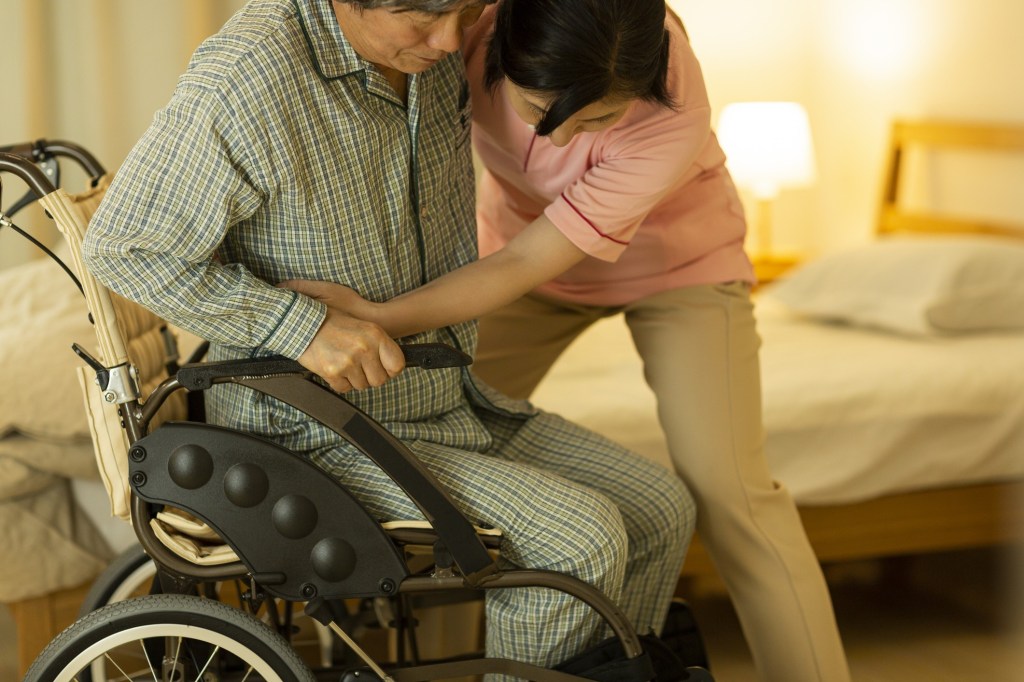
Bruce now spends his daytime hours in a high-tech motorized wheelchair.  He is completely dependent on others, mostly Lynette, for all activities of daily living.  When three of us visited Bruce and Lynette in their new home this past November, it was difficult to see his dramatic physical decline, but his spirit remained strong.  While eating lunch, Bruce asked for more chips and hummus.  Seated next to him, I asked if he would like assistance, and he replied, “We’ll see.”  With one hand he scooped hummus onto a chip, then, with support from his other hand, he raised it to his mouth and ate it.  He turned to me and smiled, saying “These days, it’s all about the little victories.”

I asked Bruce then about his prognosis, and he responded, “They’re telling me 3 to 6 months.  My goal at this point is to hold my second grandchild, who is due in February.”  Following this visit, I proposed—and he agreed—that we engage in a dialog I called “Hard Earned Wisdom,” an open conversation regarding his experience with ALS and the insights and realizations this has afforded him.  No one would choose this path to wisdom, but as Bruce has no choice in the matter, we thought it would be interesting to see what surfaced.  Bruce is a consummate teacher, and the opportunity to be of service to others was motivating to him.

Of course, when it comes to wisdom “there is nothing new under the sun,”[1] but each of us must acquire wisdom in our own way.  For Bruce, learning and practicing patience has been of central importance.  Everything takes much longer—nowadays a shower is a multi-hour affair.  ALS has also strengthened his muscles of gratitude—as he grew increasingly less able to do things for himself, he became even more profoundly appreciative of all that others—especially Lynette—contribute to make his life possible.

Bruce has found it unexpectedly difficult let go of activities and interests when it becomes clear he can no longer to do them, especially his passion for outdoor activities.  A gifted astronomical photographer, Bruce built a nice amateur observatory in their former home, and he kept at this for quite a while.  But he and Lynette decided they needed to leave that home to move closer to family, and to a home better suited to Bruce’s needs.  He now accepts that his former home, with its mountain views and observatory, is in the past, too.

When Bruce and Lynette received his diagnosis in 2021, Bruce said he felt numb, while Lynette said she went into “fight or flight” mode.  Both soon realized the importance of staying in the moment, taking each day as it comes.  This was hard at first, with ALS providers urging them to make decisions about future care, but most of that is behind them now.  Still, day-to-day living remains difficult, and is only growing more so.

I have written before about “transforming hope,” and Bruce has become a master at it.  In November the goal of holding his new grandchild was realistic and motivating, and in February it joyously came to pass.  Afterwards I asked if he had any new “hope goals,” and he told me he was hoping to attend the annual awards banquet for the Crystal Mountain Ski Patrol in late May, where he was to be recognized.  Ski Patrol was central to Bruce and Lynette’s early relationship, and friends from those days have upheld them on their journey with ALS.  This event, too, has come to pass, and they had a wonderful time.

A vignette from that banquet has stuck with me, as it speaks volumes about who Bruce is.  When he last attended this event, not long after his ALS diagnosis, someone, noticing his limp, asked if he’d had a hip replacement.  “It’s a bit worse than that,” he replied with classic understatement.  This time, when asked to speak, he went up in his motorized wheelchair, drawing every other breath from his oxygen tube, and said, “May is ALS Awareness Month, so let me tell you a little bit about it.”  ALS is a horrible disease (as Bruce always describes it), but those suffering from it are no less human for it, and still desire to be seen, known, understood, and engaged with.  I’m sure no one left that event without this awareness (or a dry eye).  As I said, a consummate teacher.

I’ve always thought ALS provides a textbook case for medical aid in dying (sometimes called “death with dignity” or, less delicately, “assisted suicide”), and I still do.  There are no effective treatments for ALS, and it usually ends in suffocation, from losing the musculature that enables breathing.  Some with ALS choose to end their lives, and right after his diagnosis Bruce thought about it, too.  Lynette told him, “It’s up to you, I’ll support you whatever you decide.”  But his symptoms were relatively mild at first, making decisions about end of life feel less urgent.  Living in the state of Washington, he knows he has the option, but he has not made definitive plans one way or the other.

Much time now is spent preparing for the end.  Bruce barely survived a long stint in the ICU last summer, and he knows that “one day soon my lungs will do me in.”  He agonizes over the burden his care needs put on Lynette—it’s a full time job for her, and she can no longer come and go, even for a short period, without someone else to help.  When his needs increased greatly following the hospital stay, Lynette found herself saying, “We said for better or for worse, but this?”  ALS truly is a horrible disease, for the patient and for loved ones.

Bruce has begun planning for his memorial service, partly because he can and partly so Lynette doesn’t have to.  He reflects, “While it’s not like I want my life to end, I’m thinking of it more now like … ‘release’ is the word I use.  I’m not in bad pain, but I’m in pain and I can’t do just about anything for myself.  And it’s release for Lynette, too.”  Lynette agrees.  Exhausted and depleted as she is, though, she has kept her promise to support Bruce in whatever he decides, sustained by a strong circle of friends and her love for Bruce.  They have the same birthday, and recently enjoyed their 49th shared birthday celebration.

During a recent conversation, following the Ski Patrol event, I asked Bruce once again if he had a new “hope goal.”  After mentioning an upcoming visit from a relative, he pivoted and said:  “On a good day, we can take our dog Luna out for a walk in the neighborhood—Luna on the leash with Lynette, me in my wheelchair.  We’ve mapped out a circuit of maybe a mile that my wheelchair can handle, and one place has a nice view of Mt. Rainier.  A day like that is a day worth living for.”  Choosing life, one day at a time.


[1] Ecclesiastes 1:9

I Can’t Believe This Is Happening So Quickly

I received a call one morning from Jacob, a nurse on the oncology unit. He said Sue, a patient I’d built a warm rapport with during an earlier stay (Telling Our Life Stories), had just arrived back on the unit and was not doing well; Sue’s wife Andrea recalled my name and asked Jacob if I could visit.

I arrive and find Sue in distressing pain, with Jacob doing all he can to make her comfortable. Andrea, whom I’d never met, rushes over to greet me.

“I knew this day would come, but I can’t believe it’s happening so quickly.” She collapses into my arms, sobbing. All I can do is quietly acknowledge the truth: dying is hard, for patient and family, no matter how ready you think you are.

After a moment Andrea straightens up and announces brightly, “Sue, Chaplain Greg is here to see you. You remember how much you enjoyed your visits with him?”

I move bedside opposite Jacob, take Sue’s hand, and greet her warmly. But Sue is past the point where comforting words and touch can ease her distress.

“I feel like I’m burning up inside. I need pain meds NOW!” Sue struggles to get out of bed, and Andrea and I restrain her while Jacob administers pain and anxiety meds. Soon Sue’s struggling diminishes, and she lays back in bed.

Jacob begins to start IV lines and prepare Sue for her stay. Andrea reaches for another hug and repeats, “This is all just happening so quickly.” As Andrea’s sobs subside, I agree to return later in the day, once their children arrive.

Death sometimes arrives with no forewarning: a massive heart attack, a brain aneurysm, an accident. Past a certain age, though, we are more likely to die from conditions that progress relatively slowly: cancer, congestive heart failure, or simply old age. This is largely a blessing, I think, as it gives both the dying person and their loved ones time to prepare, and to share conversations that can be among the most intimate and meaningful of their lives.

But this blessing brings with it a challenge: navigating many difficult decisions around whether to pursue treatment(s) for the condition(s) or to cease curative care and let nature run its course, with treatments focused solely on comfort and quality of life. In my experience, there is no “right” way to do this—so many considerations are specific to each situation and individual.

Many factors influence patients in the direction of curative care, even when the odds seem small. First, of course, is our own desire to enjoy more time and postpone death, as well as our loved ones’ desire for us to continue living, postponing the loss they will suffer when we die. Our healthcare system is also incented toward curative care: doctors and other providers are trained to treat illnesses, after all, and they make their livings—and derive professional and personal fulfillment—from providing curative care, not discontinuing it. Our prevailing cultural narrative is one of “fighting” and “battling” illness, not “giving up hope” until the bitter end.

For some, this is the course they choose, and I can understand why. A family friend was diagnosed at age 87 with lymphoma and fought it tooth and nail, undergoing excruciating treatments against medical advice—and was rewarded with 6 more years of life, replete with weddings of grandchildren and births of great-grandchildren, dying suddenly while still pursuing an active life. This outcome was far from foreordained, however, and others facing the same circumstances might wish to choose differently.

Sue’s story is more representative of my experience as a chaplain, and in life. When first diagnosed with cancer, Sue pursued curative treatments that gave her several joyous years. When I first met her, she’d exhausted most options, but told me “there’s an immune therapy treatment I could try; it might make a difference, but even if it doesn’t, it could give me more time with my wife, children, and grandchildren.” A solid choice for her, I thought then. Unfortunately, it didn’t buy her the time she’d hoped for.

There’s a term we use on my chaplaincy team: transforming hope. Not giving up hope—life is meaningless without hope—but refocusing the goals one hopes for as circumstances evolve. Sue’s hope for more time didn’t seem unrealistic when we spoke, though I don’t know what prognoses her oncologist gave her regarding pursuing immune therapy vs. discontinuing curative care—or even whether a candid discussion of these alternatives took place. It can be so hard for patients, families, and providers to refocus goals of care even when the evidence suggests they might want to.

The result of failing to do so, though, can be a crisis like what Sue and her family experienced. Andrea shared with me that it had quickly become clear Sue’s immune therapy treatments weren’t working, but their hope did not evolve to align with this reality—until Sue’s crisis made such hope untenable. Instead of gradually transforming their hope, it all had to happen so quickly …

By afternoon Sue is resting comfortably. I gather with Andrea, their sons, and an adult grandchild—a lovely family wanting only the best for Sue. Andrea says she and Sue planned for her to die at home—in the not-so-near future. Now she wants to know my thoughts. I offer that, while dying at home is an ideal we often hope for, it can be stressful if the patient has high care needs, as Sue does. I watch Andrea flash back in her mind to the scene in Sue’s room earlier that day, then shudder at the thought of trying to manage this at home.

I continue, noting that the hospital setting frees family members from most caregiving activities, so they can focus on simply being present. Andrea quickly agrees, and the other family members breathe a sigh of relief—they will approve Sue’s transition to comfort care. They share a few warm reminiscences of Sue with me, then head off toward her room. Hope is transforming before my eyes …

Sue died peacefully just before dawn the following day, surrounded by her family.

In the End, Love

As a hospital chaplain, most of the patients I visit with return to the lives they have known, generally feeling much better than the day they arrived. It is a privilege to be with them at any stage of their journey: calming jitters before surgery, helping them find strength for healing and recovery, offering blessings for a safe transition home. It feels like an even greater privilege, though, to accompany patients and their families through their final passage in life.

One morning, as I built my patient list for the day, I noted that Frieda, a 93-year-old, had transitioned to “comfort care” and was expected to die in the hospital. As I approached the door to her room, her daughter, Janet, stepped out to refill her coffee from the cart outside. I introduced myself and let her know that chaplains were available if she wanted someone to be with. She nodded numbly and went back into the room.

An hour later I received a page informing me that Frieda had just died and Janet would like a chaplain to come to the room.

I arrive and find Frieda reclined in her bed, looking very peaceful. Janet is seated bedside, stroking her hand. I pull up a chair next to Janet; she extends her free hand to me, and I take it.

“I’m going to miss her so much,” Janet begins. “She was my best friend. We’ve talked every day for years.”

“That’s really hard, Janet. Sitting here, I can feel the love between you. What would you like me to know about Frieda?”

“She was a very simple person. She grew up poor and never had much use for money, but we always had what we needed. She lived on a few acres of land outside of town, gardening and keeping horses and goats, though lately she’s only had a cat.”

“Just looking at her, I can easily imagine everything you’ve told me. I’m sorry I never had a chance to know her.”

Janet tells me that the great heartbreak of Frieda’s life was losing a teenage daughter—Janet’s sister—in an auto accident many years ago. She says Frieda has made arrangements to be buried alongside her daughter. We talk for a few minutes more, then Janet asks if I can say a prayer.

“What can you tell me about Frieda’s faith or beliefs, so I can offer prayer in a way that honors her?”

“I don’t know, I guess Christian, though we never went to church and she never talked about it. But after we were grown up and she was living on her own, she started wearing this …”

Janet reaches out and cups in the palm of her hand a locket hanging around her mother’s neck. She presses on one side and it pops open, revealing a Christian cross inside.

“That seems like a pretty big hint as to what kind of prayer she’d appreciate,” I say, and Janet smiles. So I take Frieda’s hand, completing the circle, and offer a prayer of thanks for this beautiful child of God who brought so much light into the world in her 93 years.

Later that day I greet William, a seriously ill 80-year-old moved to the ICU after a Code Blue earlier in the week. His status remains “Full Code,” so the staff will attempt to resuscitate him if his heart stops again. William is intubated but alert; he greets me with his eyes but cannot speak. A somewhat younger woman is seated beside him; she confirms she is Beverly, his wife. She thanks me for coming but says she has no needs at the time, so I depart.

Near the end of the day I take one more pass through the ICU, and I note William’s status has changed to “DNAR”—do not attempt resuscitation. As I am leaving the unit I run into Beverly in the hall.

“I’m sorry I was short with you earlier. Your colleague was so kind and helpful to me after Bill’s Code. I just wanted to tell you I appreciate your work. I’ve been in and out of hospitals with William for six years now.”

“Six years … he must be a pretty special guy,” I say with a smile. Beverly turns to face me directly.

“I’ve been married three times, and I will tell you that William is without a doubt the kindest, most loving man I have ever known. When we met, he took on my four children as if they were his own, and they love him to this day as if he were their father.”

“How many years have you been together, Beverly?”

“Thirty-seven years now, and I have loved every minute.”

I extended my hand and she took it. “That’s something very much worth celebrating. I’m happy for you that you have known such joy. What a gift!”

Beverly pulled herself into my chest and sobbed gently as I held her. “It’s so hard to come to the end, but you’re right, I have been blessed.”

Beverly then stood back, straightened herself up, and said “Well, I must head back. Thanks again for caring and listening.”

I have heard it said that when a person dies, the thin veil between this world and the next parts briefly so they can pass through to the other side. While this notion doesn’t work for me theologically, I can’t deny that as a metaphor this resonates for me.

It is my experience that there is often an extraordinary quality to the time surrounding a death, when the light and love at the core of a person’s being comes to the forefront and is beheld by all present. That’s not to diminish the sadness of a person’s death, or to deny the complex, sometimes contradictory emotions we often feel toward a loved one. It’s just that these feelings often recede in the moment, leaving us filled with awe and gratitude for that person’s life and for the gifts they bestowed upon us.

My work as a chaplain is to help grieving people notice this phenomenon when it occurs, and to offer them space to give voice to what they see and feel as they accompany a loved one through death. I don’t feel what they feel, as these are not my loved ones, but I am blessed to bear witness to the love in the room, to share in the light pouring through from the parting of the veil. It fills me with hope for all I have yet to see for myself.

Damon

My pager buzzed: “The patient in 757 wants to see a chaplain ASAP.” Damon, in his early 20s, is undergoing withdrawal from multiple street drugs. A nursing note, just posted, says he got a distressing call and now wants to leave AMA (against medical advice) to go OD and kill himself. Deep breath …

I find Damon sitting cross-legged on his bed, a nurse seated beside him. She looks at me with relief; I take her seat and she departs. Damon glances at me through disheveled hair.

“Greetings, Damon. I heard you wanted to speak to me. I’m here to listen.”

“Yeah. I heard you might have an iPad I can use. I need something to distract myself. I just found out that my girlfriend—ex-girlfriend, now—has taken my phone and money and disappeared.”

“I’m sorry, Damon—that’s rough. We have two iPads people use to attend online 12-step meetings or worship services. I can see if one is available.”

Just then a lab tech comes in to draw blood. Damon asks me to stay.

“Can I find out my blood type from this test?” he asks the tech. She says no, not unless there’s a reason to run that specific test.

“If you donate blood at the Red Cross you find out automatically,” I blurt out before catching myself, “… provided you pass their screening checks.”

“I’ve donated before, when I’ve been clean. It makes me feel good to help someone who needs it.”

The lab tech leaves, but this exchange has broken the ice.

“Everything is just so shitty right now,” he begins. “I’d been doing OK—stayed clean for nine months, got off the streets and into transitional housing. My girlfriend—ex-girlfriend—helped me stay clean, but then my mom died and I relapsed, and she dumped me and took my things. Now I have nothing.”

“That’s a ton of hard stuff coming at you all at once—no wonder you’re upset.”

“I just don’t know where to go from here.”

“Are there other people in your life who are helpful to you?”

Damon launches into his life story, filled with loss at every turn. Born to an alcoholic mother, removed from her custody soon after by his father, a recovering IV drug user. Taken to be raised by his father’s parents, who were abusive and forbade him to speak of his mother. Lost his father to Hepatitis C in his early teens. Moved to Portland when he graduated high school, fell into drug use and homelessness. Sought out and reunited with his mother in Ohio, who’d gotten sober and remarried but had never stopped looking for Damon. Inspired by his mom he got clean but then she died and his world fell apart.

“Now it’s just my stepdad, but he’s dealing with his own grief from my mom dying, and we’re struggling to get along. So, really, nobody.”

At the time of this encounter I’d been reading Demon Copperhead, the prize-winning novel by Barbara Kingsolver. It is closely patterned on Charles Dickens’s David Copperfield, but set in a world she knows well: contemporary Appalachia. I couldn’t help noting the similarities between my patient’s tale and that of Damon, the protagonist of Demon Copperhead, so I chose that as my patient’s pseudonym. Whether in 19th century England or 21st century America, these stories are all too common.

The moral challenge posed by patients like Damon is “What is my responsibility to help?” It’s the question each of us faces when we encounter people on the streets suffering from mental illness, substance use, and/or homelessness—or simply driving past tents by the side of the road. This question must have tormented Kingsolver as well as Dickens—David Copperfield was semi-autobiographical. Their response was to write these novels, perhaps hoping that enlightening readers to the conditions they experienced might open their hearts and spur them to support social reforms.

I don’t have a good answer to this question for myself. I have no illusion I can solve the problems on the streets of Portland, any more than these novels could fix the places in which they were set. At the most basic level, I simply try to encounter people where they are, in their full humanity, as fellow children of God. It often scares the shit out of me—“Deep breath …” in my first paragraph is an understatement—but I’m usually rewarded by the person transcending any stereotype I may have formed in my head.

I don’t think this question will ever stop challenging me, and I hope it doesn’t. The calling to “comfort the afflicted and afflict the comfortable” resonates deeply for me. It forces me to acknowledge my own comforts and it spurs me to comfort others any way I can. I don’t have the gift to write great novels, so I do this. All that most of us can do is try to enlarge our comfort zones bit by bit to encompass an ever-larger swath of humanity. They all need what we can offer—and we need what they can offer us.

Damon and I talk about places where he might be able to build supportive relationships. He says there are a couple of good people in his transitional housing situation that he might be able to look to for peer support. We also talk about work.

“It’s so frustrating. I’m getting interviews, even second interviews, but still nothing. I’m a good worker and I have a good resume. I’ve just got to keep trying.”

I offer words of encouragement without minimizing the difficulty of the place in which he finds himself.

“Don’t worry,” he responds, “I haven’t given up hope. I know what that looks like, I’ve seen it in people on the street. You just look in their eyes and see there’s nothing there, they’ve given up. That’s not me.”

As I write this I still haven’t finished reading Kingsolver’s novel, so I don’t know how things work out for Demon Copperhead. I don’t know how things will work out for Damon, either. I do know that, when I saw him, he was being kept safe and was receiving medical and psychiatric care as well as social services, so that encourages me. When our eyes met before parting, I saw a determination, however fragile, to get better, to do better, and to serve others like himself.

I’d like to think my conversation with Damon helped him pull back from despair to a place where he could get better and emerge stronger. I don’t know that, though, and the odds are against him. I feel the same way about so many patients I see. But, as Damon said, I haven’t given up hope—that’s not me.

Telling Our Life Stories

It was a lighter day at the hospital, so I reviewed charts on the oncology unit to identify patients who might welcome a visit. Sue, in her 70s, had lived with metastatic breast cancer for a few years; she’d been admitted for intractable nausea, which was starting to settle down. After ruling out other causes, her doctors had concluded it was the spread of her cancer itself that had caused the nausea.

I knock and introduce myself, and Sue welcomes me in.

“It’s nice of you to stop by. I was raised Catholic but haven’t really followed any religion as an adult.”

“That’s true of a lot of patients here. We chaplains are here to discuss matters of faith for those who want that, but mostly we’re here just to offer company and to listen to whatever is on your heart.”

Sue thinks quietly for a minute, then speaks. “I was hoping my nausea was something else, but they tell me it’s my cancer moving to a new phase …” She begins to tear up.

“I’m sorry, Sue, that’s hard news to hear.”

“I’ve been through surgery, chemo, and radiation, but those aren’t options now. There’s an immune therapy treatment I could try; it might make a difference, but even if it doesn’t, it could give me more time with my wife and our children and grandchildren. I think I want to try it.”

“I can understand why you might. What would you like me to know about this family you love so much?”

“Well, my wife and I both have children from previous marriages who are about the same age, and they have all become close, especially as they had their own children.”

“That’s wonderful!”

“I should back up a minute. I grew up in a family that was loving but very conservative … I’m sorry, you don’t really want to hear all this, do you?”

“Oh yes I do. This is what we do. I love hearing all about the interesting lives people have lived.”

“OK, then …” and Sue is off and running with a beautiful tale of how she and the family who loves her today came to be.

More and more each day, as a chaplain and as a human being, I appreciate the power and beauty of what we call “life review”: one person sharing with another a story of their journey through life that brought them to the place they find themselves today.

Engaging in life review is by no means limited to the later stages in life. It is precisely what people in the budding stages of romantic relationships share with each other, whether as teens or starting anew in their fifties. Most of us remember the thrill of this well. Regardless of the hard parts along the way—or perhaps especially because of them—it is immensely meaningful to tell one’s life story to another person who demonstrates genuine interest. We are wired for this, as storytellers and as listeners.

That said, I think life review takes on greater significance as we age, yet often the need for it goes unmet. “Yes, dad, we know that story about the time your car burned up on the turnpike” is a classic. I know I’m as guilty as anyone of repeating my stories, yet I’m always grateful for new ears to tell my stories to. I’ve come to believe that telling our life stories—and having them validated by listeners—is one of our principal means of reassuring ourselves of the significance of the lives we’ve lived.

Sadly, we often wait too long to make time for engaging with our elders in life review. My favorite memorial services feature people telling stories about the departed, but often many in attendance—even close family members—say to themselves, “I had no idea.” Years later we might ask, “I wonder what Mom felt when she first saw Dad after he came back from three years at war,” but the opportunity for that conversation is gone.

These thoughts have whetted my appetite for seeking out and listening to the life stories of people of any age, and I try to encourage others to do the same. It is gratifying to know that, in doing so, we are helping them feel the benefits of having their stories heard. Just as important, though, is what we can gain from it. In a recent column Anne Lamott said, “When my friend Pammy was dying at the age of 37, her doctor told me, ‘Watch her now, because she’s teaching us how to live.’”

Three days later I’m back on the oncology unit and I pop in to greet Sue again before she discharges home. She appears momentarily confused, asks me to repeat my name, then smiles.

“You’ll have to forgive me, these meds make my brain a bit foggy. I do remember you visiting me.”

“No problem at all, the meds can do that. I really loved our conversation, and I wanted to see how you are doing today.”

“I’m definitely feeling better. My nausea is gone, though I’m still pretty weak. I’ll start immune therapy treatments on Monday, and I’m hopeful they will do some good. But I’m sad that I won’t be able to return to my work—it’s just too demanding.”

“When we spoke last time you didn’t mention your work. It sounds like it’s been an important part of your life. Would you be willing to tell me about it?”

“I’d love to. I’ve done a lot of things, always having something to do with photography. It all goes back to when I was in high school. I was always good in art, but then I had this teacher … I’m sorry, you don’t really want to hear all this, do you?”

I smile and say, “Of course I do.”

Sue smiles back. “That’s right, of course you do. As I was saying …”

Here for Each Other

It is late 2021. I listen in stunned silence as my urologist goes over my prostate biopsy results. After years of monitoring my PSA levels had begun climbing, and now I know why: “Grade Group 3 = Gleason 4+3=7” is as cryptic as it gets, but its interpretation—“Intermediate Unfavorable”—is not.

This is a story of how friends can show up for one another—and, in particular, how friends showed up for me at this moment. It begins fifteen years earlier, and the community from which it arises goes back yet further. These memories are filtered through my own lens of experience. I have shared what follows with each friend and I have incorporated their memories—filtered through their own lenses—to land closer to the truth. The story is ultimately mine, but each friend agreed to include their story for any benefit it might bring to others.

It is 2006. Rosalie, a physician in my Quaker meeting, is bringing a prepared message to our worship, wearing a brightly colored scarf wrapped around her head. She thanks our community for the support she’s received since her breast cancer diagnosis and subsequent mastectomy and chemotherapy.

Then Rosalie unwraps the scarf, revealing her gleaming bald head. Many in worship gasp, and she continues. “I’m the same Rosalie I ever was, but I have now joined an elite group that includes Mitch [a bald member of our meeting] and Yul Brynner.” She continues in a light-hearted tone, and we all breathe more easily, knowing she is back.

One of the first things I noted when I began participating in Quaker community 30+ years ago was the openness with which others shared the truly hard parts of their lives—and requested and received support from the community. What struck me as Rosalie spoke that day was her transparency, as if to say, “I share this with you because you are my friends, and I want you to know me as I am today, with no mystery and no embarrassment.” I decided then that this was someone I wanted to know better.

It is 2009. Caryl, the first friend I made among Quakers, asks me, Rosalie, and a couple of others to support her during a difficult period at work. We do so, expecting to gather for only a year or two, but Caryl’s work remains volatile. Meanwhile, life goes on and we journey through it together. In 2011 Caryl, widowed twenty years earlier, marries Jeff, a more recent widower, and we celebrate a joy that neither anticipated ever experiencing again.

Two years later Caryl shares the hard news that she’s been diagnosed with Parkinson’s disease, about which it is often said “the only thing predictable is unpredictability.” Over the years, as Caryl’s Parkinson’s advances, Jeff begins participating actively. Today, several friends continue to share intimate gatherings in support of Caryl—and Jeff.

“Anchor committee” is one of several flavors of spiritual care committees, a practice common among (but not limited to) Quakers. The goal of a spiritual care committee “is to provide sustained support, guidance, and accountability throughout the duration of the need.”1—exactly what Caryl requested.

I love the image of an anchor committee—friends gathered to offer a friend stability and centeredness during a stormy period in life. The document in the footnote provides helpful guidance for how to support effectively as a group, but such groups need not be grounded in religious faith or communities.

It is 2011. Fred, a long-term member of our Quaker meeting, has been diagnosed with frontal lobe dementia and ALS, which are closely related. Many of us don Fred’s favorite striped shirts for a Walk for ALS along the Portland waterfront, joined by students from Fred’s teaching years. We all watch as, week by week, these diseases break Fred’s body, challenge his spirit, and tear a hole in the heart of his wife, our beloved Peg, a spiritual director. It becomes clear that an upcoming birthday will be his last, and Fred asks for a community birthday party so he can celebrate it with us.

Our friend Mike helps organize the gathering, and asks Fred what he would like. Everyone dressed in striped shirts, and lots of music, especially Beatles. Mike presses Fred for specific songs, and Fred—by now struggling to breathe—sucks in all the wind he can summon and answers, “Why Don’t We Do It In The Road.” And so it comes to pass that a hundred of us gather in striped shirts for an evening of musical celebration of Fred, including a raucous rendition of Fred’s requested song.

Fred’s birthday party is one of my defining images of what it means to be a caring community of friends. It is tremendously sad to watch a beloved friend become wasted by disease, and many find it difficult to spend time with such a person on the cusp of death, saying a real and final good-bye. But death comes to all of us and it is far worse, I believe, to walk through this alone. When it’s my time, I hope to go like Fred, surrounded by friends like these with whom I have truly shared life’s journey.

I share my cancer diagnosis with my family and with my Quaker community. I get a call from Rosalie. “Greg, it seems you might want a care committee. I’m happy to convene one for you. Who would you like me to invite?” I agree, and my answer includes Caryl, Jeff, and Peg. All agree to serve. My wife Diane is offered the option of joining and she accepts. It’s her journey, too, of course.

I am more accustomed to offering care, and it is humbling to share as vulnerably as these friends have shared with me–but my trust in them is complete. In our first meeting Rosalie, no stranger to cancer, asks “Have you given your tumor a name yet?” I pause and reply, “The Beast.” She counters, “That seems like a name you’d share publicly. How do you address it directly?” I wince at being called out—remember that word “accountability”?—but I center and let my emotions rise. “YOU MOTHERFUCKER!!” I bellow. Rosalie smiles and continues, “Now that sounds more authentic. Do others have questions?” We are off and running.

To live in this world you must be able to do three things
to love what is mortal
to hold it against your bones knowing your own life depends on it
and, when the time comes to let it go, to let it go.

Mary Oliver, from “In Blackwater Woods”

As friends in an intentional community, we have made the commitment to love each other despite our mortality, and to hold each other close, especially when our lives depend on it. While our Quaker meeting is a religious community, religion is not essential—my wife’s long-running cooking club has moved increasingly in this direction as its members confront the ravages of aging. What matters most is a group commitment to show up for and love each other, come what may.

It’s never too early to ask, “Who are these people for me?”

  1. A Care Committee: A Ministry of Prayer and Learning Devoted to the School of the Spirit is under the care of the committee on Worship and Care of Philadelphia Yearly Meeting of the Religious Society of Friends. ↩︎

Peace

Betty was in her early 80s, admitted for a bleeding mass in her esophagus that seemed likely to prove malignant and inoperable. She’d requested a chaplain visit overnight, so I made her my first priority that morning.

“Greetings, Betty, I’m Chaplain Greg. Thanks for inviting me to be with you.”

“I’m so happy to see you. I’m doing well this morning. I have been blessed to know Jesus Christ as my Lord and savior since I was a little girl.”

“What a joy that is! I’m happy for you!”

Betty proceeds unprompted with “life review,” sharing about her 60-year marriage to her husband, a retired pastor with several chronic medical conditions, and their children and grandchildren, who continue to play an active, supportive role in their lives.

“Now it seems my time may be coming … I’m excited to finally meet Jesus face-to-face, though I worry a bit about my husband. We’ve always talked that he’d be the first to go, given his health, but now it looks like I may be. Still, I trust God to care for him as He always has, and our children will be there for him, too. And it won’t be much longer until we are together in heaven.”

My friend John asked me at dinner recently, “What percentage of the people you see nearing end of life are at peace with their situation? What factors seem to make the difference?” I am under no illusion that I have definitive answers to these questions, but I’ve seen enough to offer a few thoughts.

My answer to John’s first question was, “Maybe 60%, maybe more.” Betty is just one example among several since our dinner. I will continue to keep this question in mind over the coming months as I go about my rounds, but it feels right, at least for the population I see in the hospital where I work. John’s second question—“What factors seem to make the difference?”—is harder.

Religious faith is an important source of peace for many facing death, but it’s no guarantee—for some, their faith can elicit a sense of having fallen short of what was expected of them in life, and fear of the consequences. And I’ve seen plenty of patients with no active religion, or even explicit atheism, who seem fully at peace with their imminent deaths (Clark, The Science Teacher, is one example).

One factor uniting Christian Betty with atheist Clark is a sense of wonderment about the source of their existence and the universe we inhabit, as well as deep gratitude for the life that this source provided. Gratitude is a theme that runs through so many of the patients I see who are at peace, even (or perhaps especially) in those whose lives have been remarkably difficult (for example, Dean in From The Ashes).

Lucy, in her 50s, was a new admission to the oncology unit but no stranger to cancer. Her lung cancer, diagnosed 10 years earlier, had been managed with surgery and chemotherapy, but after recent headaches and dizziness she was re-evaluated and found to have tumors throughout her brain. She made a request for a chaplain visit the night she was admitted.

Lucy greets me warmly as I arrive, guessing correctly from my attire that I’m the chaplain she’d requested. She gets right down to business.

“It looks like this is it,” she begins. “I’ve had a good run and gotten a lot of extra years, but I’ve always known this day would come and now it’s here.”

“I’m sorry, Lucy—that’s difficult news, even if you are prepared for it. How’s that sitting with you this morning?”

“I’m mostly OK. I’ve got my affairs in order, and I’ve discussed this possibility with my kids for years, so they’re as prepared as they can be.” Her voice trails off but her eyes remain engaged. I wait for more.

“What I really wanted to talk to you about is my sister, who I haven’t spoken to in years. We got along well enough growing up, but as an adult she became really mean and cruel to me.” Lucy relates an escalating series of events, culminating in an act of betrayal that led Lucy to cut off communications between them.

“That’s heartbreaking, Lucy,” I reply, “but I can understand why you felt you needed to set that boundary in order to protect yourself.”

“I don’t regret it, but I realize I’m still angry about the way she treated me. I don’t want to die angry. I wanted to talk with you about how I can forgive her—I think I need to find a way to do that in order to die in peace.”

So we talk about how forgiving another person is something one can do on one’s own. It doesn’t require anything of the person being forgiven, no matter how much one might wish for an apology or just an acknowledgement of hurt. It doesn’t even need to be communicated to the other person. Forgiveness is something one can offer for the sole purpose of putting one’s own heart at rest.

“I never thought about it that way at all, but now that you say it, it makes perfect sense. I think I’m ready to start writing down what I want to say. I’ll figure out later if I actually want to send it to her.”

Every time we chart a spiritual care encounter, we are prompted to assess the patient/family regarding “Forgiveness/Peace.” At one end of the scale, 1 = “Sense of reconciliation” and 2 = “Still have some things to reconcile.” In this context, reconciliation means “Is the patient/family reconciled with and at peace with their situation?” It doesn’t necessarily mean “Have they reconciled with the important people in their lives?” but it certainly can. In fact, the other end of the scale is 4 = “Distanced from others” and 5 = “Alienated from others,” reflecting the importance of relationships in finding peace.

Betty and Clark are good examples of “1” but I’d say the “2” I gave Lucy is more common, especially in the early days of a hospitalization. Most of us have some Unfinished Business (to cite yet another post) that we need to take care of, and a medical crisis can prompt us to take steps to heal relationships that we may have long been putting off. One of the most important things we can do as chaplains is to serve as a sounding board to help others identify the unfinished business in their lives so they can begin to move forward toward peace.

That night at dinner, I told John I thought one of the biggest factors impacting a patient’s sense of peace is having enough time to prepare for end of life. I would now frame that differently: it’s having very little unfinished business—especially unreconciled relationships that need to be set right in order to be at peace. It’s a helpful reminder that it’s never too soon to begin that work …

Duncan Turns 70

I rise to do my morning yoga, and I realize it is Duncan’s birthday, his 70th. My mind is immediately flooded with memories of our lives together, which grow in meaning for me with passage of time. The mark of a true lifelong friend.

I am 11, and my parents have moved me from the overcrowded parochial school that is all I’ve known to a small private boys school. I know almost no one there, and it feels like the others have been together for years. I have no clue how to fit in to the culture and can’t wait for each day to end. Before long, though, a goofy-looking red-haired kid, who seems well liked by everyone, invites me to spend the night at his home. I have more fun than I can ever remember, and when I return the favor it is even better. In short order I am “one of Duncan’s friends,” and school life is suddenly easier.

That summer, much to my delight, my parents move our family to a house two blocks from Duncan’s. As we enter 7th grade, we begin walking to and from school every day, a practice we keep up through high school graduation. We spend afternoons and weekends together, too, listening to the Beatles and the Grateful Dead, sharing a love of the Colorado mountains, getting in good trouble (and bad) together, and always having each other’s backs.

I watched Duncan exercise his superpower of radical hospitality many times over these years. If a kid seemed lost—or, even worse, ostracized—Duncan would reach out, bring him into our ever-expanding circle, and simply say, “Jeff’s cool”—and it became so. Though I’ve tried, I’ve never been able to do this as intentionally and seamlessly as Duncan. There are many who, like me, revere Duncan for the quality of his friendship. My bond with him somehow feels unique, but others feel the same way about theirs.

There is a shadow underneath Duncan’s sunny disposition, though, and I understand why. He is the youngest brother in a patriarchal family led by his maternal grandfather; many mornings his grandfather and older brothers are gathered over business at the breakfast table when I arrive for Duncan. I sit on the steps nearby and can’t help overhearing them berate Duncan as a loser who won’t amount to much. They may think they are challenging him to raise his game, but I can watch him slowly internalize their messaging.

We are juniors, and our math teacher is called out of the classroom for a moment. We seize the opportunity to look through the grade book sitting on his desk. Everyone’s grades are pretty much as we expect, but we note an unmarked column of numbers that we determine are IQ test scores. We are stunned to see that Duncan has the highest score of all, even though his school performance is below average. We declare him the most underperforming student in the school, in the spirit of rebellious admiration, but I can watch Duncan internalize this label, too.

As I reflect on the depth of our friendship during these years, I recognize we are kindred spirits in more ways than I could see at the time. I, too, had older siblings that I felt I couldn’t measure up to, and a home I longed to escape from. I, too, had been startled to learn that my IQ score was quite high, only slightly lower than Duncan’s; for me, though, this news gave me confidence that if I cared more I could do better, and I began to respond accordingly.

I head off to college and Duncan follows me out to Portland, though to a different college due to his lower grades. He never returns for a second semester, instead taking an entry level job in the family business. I try to connect with him during trips back to Kansas City, but with little success. I see his lovely mother the day before our 20th high school reunion and she tells me Duncan is excited to see me there, but he ghosts all events he has signed up for. Years later he serves as an intern on a geology field project led by one of my sisters; she says he seems great, and would love to see me.

It is 2007, and my father has died. At my sister’s urging, Duncan shows up at a post-memorial gathering at another sister’s home. Duncan’s red hair has turned white, but it is as if nothing else has changed. We hug tightly, cry copiously, and spend several hours filling in the blanks of the years gone by. Duncan has bounced around in his work and his relationships, but drugs and alcohol have been steady companions. Duncan tells me he has no liver left and is on borrowed time. It is a shock but not a surprise when we learn later that year that he’s been found dead, slumped over his guitar—52 years old.

Duncan lives on in the lives of those he touched. Several of us exchange emails whenever stirred by memories of Duncan, most recently when Phil Lesh of the Dead died. We do so again today, on his 70th birthday. We all miss him dearly. I was blessed to have him in my life when I did, and I am blessed to have a community of friends and family with whom I can share his memory today.

I’ve never succeeded in conveying Duncan’s profound spirit to anyone who didn’t experience it directly. On one level he was simply someone who never amounted to muchas the men in his family predicteda slacker who squandered the benefits of a privileged upbringing. But, as I’ve experienced often, such a surface can obscure a rich, complex, and spirit-filled human within, and that person’s spirit can create a ripple deeper and more powerful than anything one might easily observe.

Duncan helped me believe in my own self-worth in ways that no one else had before, and he taught me that even the most unlikely people are worthy of friendship and respect. Duncan’s spirit continues to inspire and inform my work in chaplaincy today.

More stories of Duncan are contained in the beautiful New Yorker article Scars, written by David Owen, another member of my class touched deeply by Duncan. I am “Henry” in this article, a moniker I carried throughout these years. The photo of Duncan accompanying this post was taken by David in the San Juan mountains of southwestern Colorado, a place we all thought of as heaven on earth.

We’re All Human

During my clinical internships, a patient request came in to the chaplain’s office, where several of us were gathered.

“It’s for Willy,” one of the chaplains announces to the room. The others nod.

“Hey, Greg, this would be a good one for you,” she continues. “Willy’s in and out of the hospital a lot, we all know him. He’s a nice guy and loves chaplain visits, but he can be demanding so we try to share the load. Your turn today.”

I review Willy’s chart, which reveals a history of IV drug use and homelessness, though he is now clean, sober, and housed. He has several chronic medical conditions, including a heart condition I’m not familiar with: endocarditis. I mention this to one of the chaplains.

“Ah, yes, we see a lot of that, especially with patients like Willy. You’ll want to read up on it at some point. But you don’t need to know anything about it for your visit.”

So I head off, and Willy is just as advertised: Grumpy to see yet another new chaplain, but softening slowly as we engage. Grateful for company, happy to share about his religious upbringing and the twists and turns of his life, and appreciative of prayer. While difficult to disengage from, he leaves me hoping I will see him again—which I do. A beautiful, complicated human.

Endocarditis is an inflammation of the lining of the heart, characterized by lesions, called vegetations, that are as strange as anything I’ve seen in medicine. Visualized via echocardiogram, they remind me of strands of kelp floating in a sea bed. Needless to say, that’s not a good thing for one’s heart valves or overall health, and it can be difficult to treat.

Endocarditis is usually caused by bacterial or fungal infections, and there are many risk factors that make people susceptible to it. The most prevalent, at least in the population served by my hospital, is IV drug use. That’s one of the reasons my chaplain colleague thought a visit with Willy would be a valuable part of my training experience.

A year later I am called to a “rapid response” for Vivian, a patient on the floor where I’d visited Willy. This term means there has been an unexplained change in a patient’s condition. While often not serious, chaplains always respond in case visitors are present who may be distressed by the change in the patient or by the flurry of responders. This time there are no visitors, but it’s clear Vivian’s situation is not good. I stand aside as she is whisked down the hall on a gurney to the ICU. I check with her bedside nurse and learn that Vivian is visited daily by her husband as well as other family and friends.

I return to the chaplain’s office to scan Vivian’s chart, where I learn that, in addition to cancer, she’d been receiving treatment for endocarditis, possibly caused by an infection in her chemo port. I then head to the ICU, where providers of all kinds are rushing in and out of her room. The charge nurse spots me quickly and says, “We need you to take point with the husband, who’s on his way.” She paused to get an update from another nurse, then turns back to me. “He just arrived in the waiting room.”

What follows is some of the most difficult work I’ve done as a chaplain: Conveying the gravity of Vivian’s condition without prematurely extinguishing hope. Accompanying her husband through shock and grief while helping him spread the news of Vivian’s situation to loved ones. Welcoming family members to the ICU waiting room and gathering them for updates from doctors working to save Vivian’s life. Steadying them through new waves of grief as they receive the news that nothing more can be done. Keeping vigil with them in the waiting room as the staff prepare Vivian’s room for all to gather to say their good-byes, then accompanying them back to see her. Through it all, we share many tears and prayers.

In the agonizing waits between updates, I ask her loved ones what they would like me to know about Vivian. I learn that she is a committed life partner, a hard worker, a person of bedrock faith, a loyal friend, the life of a good party. All I can say in response is that she sounds like someone I would like to know. Yes, they say, everyone loves Vivian.

I step outside of Vivian’s room to speak with Dr. Weiss, who’s been leading the charge to save Vivian’s life. He is busily charting the care that had been provided to Vivian.

“This might take me a while,” he says tersely, without looking up.

“I understand, I will wait,” I reply as calmly as I can manage.

After 30 seconds or so he stops typing, hangs his head for a moment, then turns toward me. “I’m sorry. What’s your question?”

“I’m trying to prepare the family for the next step, which I suspect is you explaining the process of disconnecting life support.”

He nods. “I need a few minutes, but I don’t want to wait too long, either. What do you think?”

“Five minutes is probably about right. Give me a couple of minutes, then come in whenever you feel ready.”

He nods again, then pauses. “You know, when I saw she had endocarditis, I just assumed she was a drug user, though I realize now that she’s not. I’m sitting here feeling like a complete asshole that this thought even crossed my mind, because it shouldn’t—and didn’t—change the care we gave her. Still, I feel terrible that I thought it anyway.”

“Well, if it’s any consolation to you … I went through the same thought process. I don’t think that makes us assholes, I think it just means we’re human.”

We share a brief nod and smile, then resume our duties.

The Trappist spiritual leader Thomas Merton urges us “to resolutely put away our attachment to natural appearance and our habit of judging according to the outward face of things … Our job is to love others without stopping to inquire whether or not they are worthy.”1

Like many spiritual teachings, I hold this as an ideal to which I fervently aspire, but most days I fall short. I’m only human, and this habit of judging has usually run its course before I even recognize it happening. Dr. Weiss is only human, too. Same for Willy, for that matter. I know we’ll all keep trying, but we’ll also keep failing. We’re all human, and that’s the best we humans can do.

I’m just grateful we have each other to look to for support when we do fail, and a Creator with infinite compassion for our limitations.

  1. For the full context of this quote please see: Thomas Merton on Loving Others ↩︎

Toxic Theology

I was paged to a “Rapid Response” on my hospital’s inpatient rehab unit, as Carla, a patient engaged in physical therapy, had suddenly become unresponsive. As usual, I sought out family and was quickly introduced to Carla’s husband, Randy, and his brother. They seemed unusually calm.

“It’s probably just a medication imbalance,” Randy began. “This has happened before. But thank you for coming, Chaplain. We’re Christians and we believe in the power of prayer—Carla’s got an army of prayer warriors pulling for her.” Randy’s brother nodded.

“Can you tell me what brought Carla to our rehab unit?” I asked.

“She was shot two months ago in a robbery at a grocery store in the small town where we live. The bullets did a lot of damage, and after the wounds healed they sent her up here to Portland to regain as much function as she can. She’s been doing well, though there have been setbacks … like this.”

“Oh, I’m so sorry. That’s just terrible.”

“The hardest thing …” Randy said, “is that we saw the whole thing on film from the security cameras. I guess she didn’t get down fast enough for the robber. He shot her once and then, when she was lying on the ground, he shot her two more times for no reason at all. I just can’t understand evil like that.”

Just then Randy needed to provide information to the medical team treating Carla, so I told him we’d keep them all in our prayers, then departed.

The problem of evil has challenged thoughtful people from the beginning of time. We humans have an instinctive impulse to try to understand cause and effect, to find meaning or make sense out of our experiences. When a person dies unexpectedly or has a life-shattering experience, we can’t help but ask why. Often, there are no answers available.

The problem of evil has an extra dimension for people who believe in a god with the power to influence human affairs. This problem has its own term, theodicy, used by philosophers and theologians who wrestle with it. No one gets through seminary without studying different schools of thought on this topic, and no one graduates without having to develop a personal point of view on it.

I was forced to reckon with the flimsiness of my own fledgling theology more than 25 years ago, when the spouse of a work colleague was brutally murdered. I wrote about this experience during my first year of seminary (God Not Feeling Omnipotent), and I have continued to test and refine the point of view expressed in that post ever since.

A few days later Carla was on a medical unit I was covering, and I looked in on her. During previous visits she’d been surrounded by family and appeared confused, but this evening she was alone and alert.

“Oh, hi, Chaplain. Thank you for coming to see me.”

“Greetings, Carla. It looks like the fog of the past few days has cleared. I’m glad to have a chance to meet you properly.”

“Yes, it was the meds, but they adjusted them and now I can think again. Do you have a few minutes?”

“Absolutely, that’s why I’m here.”

“I’ve been sitting here thinking about why this happened to me. I’m grateful that lots of people are praying for me, but they keep saying things like ‘Everything happens for a reason’ and ‘This must be part of God’s plan.’ Those sayings don’t make any sense to me right now.”

“Can you say a little more?”

“Well, if this is God’s punishment for something I did, I can’t figure out what I did to deserve this. I know I haven’t lived a perfect life, but I’ve tried to follow God’s commandments. I probably won’t ever walk again. How is that fair?”

“I agree, it really doesn’t seem fair.”

“And how is this supposed to be part of God’s plan? Would God purposely do this to me so that I might learn some lesson, or so that other people might benefit from my example?”

I pause, then reply. “The God I believe in doesn’t act that way.”

“The God I thought I believed in wouldn’t act that way, either, which is why this is so confusing.” Carla’s eyes fill with tears, and her voice quivers. “Why did God do this to me? What do you think, Chaplain? Tell me.”

I offer my hand and Carla takes it. We share silence together as I let my own feelings rush in, and then I try to gather my thoughts.

“Carla, I’ve had to change my understanding of God over time in order to make sense of situations like yours. The only God I can believe in is always on the side of love, always working to heal our brokenness. That God would never say ‘Let’s put a couple of bullets in Carla to teach her some humility.’”

Carla laughs through her tears. “Thank you for saying that. I can’t imagine God being that way, either.”

“On the contrary, I believe God was doing everything in their power to stop the robber from shooting you. But I’ve had to conclude that God doesn’t have the power to stop something like that. I’ve had to let go of the idea that God is all powerful in order to hold onto the idea that God is all loving.”

“That’s a lot to take in …” Carla responds uncertainly. “But I do believe that God is all loving.”

“And I believe that God has been with you throughout this ordeal, including tonight, working to heal your body and, especially, your spirit.”

We close with a time of prayer, giving thanks to a God who loves us through our pain and doubts.

Toxic theology is all around us. It may wear the cloak of religion (“It’s all part of God’s plan”) or it may simply be part of the cultural air we breathe (“Everything happens for a reason”). It often arises as we try to make sense of things that make no sense, as we try to assert control over events or emotions that feel out of control, as we seek safety when we feel vulnerable. While it may at first be benign, we often give it power over domains where it can be destructive without ever realizing what we have done.

Any theology, whether religious or secular, can become toxic when we seek to apply it to other people. Carla’s prayer warriors were no doubt well meaning, but they assumed their theology applied equally to Carla without having any experience of Carla’s suffering. I always have trepidation when a patient asks me about my own theology, especially from a place of vulnerability, as I don’t have their life experience and don’t know what conflicts it may create for them. I can only speak from my own experience and hope they find something of value in my words.

We live in a time when, as much as ever, people are seeking to impose their world view on others without first seeking to understand the experiences of others that shaped their different world view. I am grateful for every opportunity I get to listen deeply to the life experiences of others. I always come away convinced of the power of love to bridge our differences.