
The Matriarch

I enter the room of Tara, a woman in her early 40s dying of liver failure caused by alcohol abuse.  She transitioned to comfort care the day before.  She is lying in bed, her skin a deep yellowish green, her mouth wide open, breathing deeply.  On the far side of her bed, an older woman wearing a sweatshirt sits quietly, knitting.  She glances up with a look that tells me I am welcome to join her.

“I’m Chaplain Greg.  I’m so sorry this is happening.  How are you doing today?”

“I’m Jackie.  I’m just doing the mom thing.  Not much else to do at this point.  She’s my girl.”

“What would you like to tell me about Tara?”

“She’s too much like her dad,” Jackie proceeds, looking over at Tara.  “He drank too much, never stopped acting like a teenager, so I had to kick him out while she and her brother were still young.  I met Ray, a good Christian man, and he helped raise my kids like they were his own.  But when Tara hit her teens, her dad would take her out drinking, and it’s been a problem for her ever since.”

“I can only imagine how heartbreaking it would have been for you to watch that happen.”

“It was.  Don’t get me wrong, she’s been a wonderful daughter and mother, but she could never shake the liquor.  She was in here last month and got told that if she took another drink it might kill her, but I guess she didn’t believe it.  So here we are …”

“You mentioned Tara was a mother … how old are her children?”

“She had a son young, who’s now got a one year old daughter of his own.  She also had a son by another man, and he’s now five.  She had a lot to live for.”

“This must be so hard for her family, especially her younger son.”

“It is, but he’ll be OK.  We’ll raise him right, with God’s help.  We’ve got a strong family that will help, too.  He’s already in his uncle’s pocket.”

At Jackie’s request, we shared prayers for her many concerns.

It’s been a rough few months for mothers of dying adult children, at least in my world.  On the same week that I visited Jackie, I accompanied the family of a woman killed in a motor vehicle accident—including her mother, husband and adult children—on an organ donor honor walk.  Sadly, though, the cause of death is usually alcohol or drugs—as was the case for Jackie, for Jean in the story A Hero’s Farewell, and for so many others …

In fact, I’ve been involved in so many situations like this during my brief chaplaincy career that it’s hard not to see an archetype emerge, embodied by Jackie.  Grief-stricken but steady at the bedside.  Loyal to their dying child despite the failings that hastened their child’s death.  Committed to the care of the family left traumatized by their child’s premature death.  And present, always present.

Like any archetype, this image of a matriarch never applies perfectly, nor in every situation, but it persists all the same.  Even when the patient’s situation isn’t grave—say, gall bladder surgery—it never surprises me to find a mother at the bedside.  I once teased my father for worrying so much about one of my adult siblings, and he responded, “When your children are adults, you’ll understand that you’re never done being a parent.”  I understand that now.

As a male, I often wonder in these situations, “Where are the fathers?”  They are sometimes present—and caring in the same way I described the matriarch—but more often not.  Perhaps they are no longer living—men do have a shorter life expectancy, after all.  Perhaps they split with the mother and became estranged from the family.  Usually their absence is simply never mentioned.  I won’t speculate further regarding the absence of fathers, but I can’t avoid noting it. 

This archetype has its roots a long way back … including one of the most famous matriarchs of all, who is celebrated by many at this time of year.

Simeon came into the temple; and when Jesus’s parents brought in the child to do what the law required, Simeon took him in his arms and praised God.  Simeon then said to Mary, his mother, “This child is destined to be a sign that is rejected; and you, too, will be pierced to the heart.”  Luke 2: 27-35 [selected]

This passage comes from the same chapter of the Bible as many classic Christmas stories, but it’s rarely included—after all, that last sentence is not exactly “good news,” at least not in the traditional spirit of the season.  I also note that Simeon directs his prophecy solely to Mary—Joseph, the father, is already disappearing into irrelevance.

Jesus’s mother and brothers arrived [where he was speaking]. Standing outside, they sent someone in to call him.  A crowd was sitting around him, and they told him, “Your mother and brothers are outside looking for you.”  “Who are my mother and my brothers?” he asked.  He looked at those seated around him and said, “Here are my mother and my brothers!”  Mark 3: 31-34

This context makes clear that, by the time of Jesus’s ministry, his mother Mary had assumed the role of matriarch of the family that Jesus (and, though never mentioned, Joseph) has left behind.  Mark says nothing about how Mary received these words of Jesus, but it’s easy to imagine she would have been “pierced to the heart.”

Near the cross of Jesus stood his mother, his mother’s sister … and Mary Magdalene.  When Jesus saw his mother there, and the disciple whom he loved standing nearby, he said to her, “Woman, here is your son,” and to the disciple, “Here is your mother.”  John 19: 25-27

No matter how Mary felt about Jesus’s previous words, or anything else that transpired between them during the time leading up to his death, the gospels tell us she was right there at his side as he died.  And she was acknowledged by Jesus as the matriarch—not only of Jesus’s biological family, but also of at least one of the “brothers” who were seated around him in the earlier passage.

This season I feel led to lift up the many mothers who have endured suffering, rejection, and loss, yet keep showing up, keep offering a steadying presence to their families in the face of seemingly unending challenges, and keep practicing hope despite abundant cause for despair.  I am blessed to encounter you everywhere I turn.  You are seen.  You amaze me and inspire me.  Thank you for your presence in my life.

Women on the Verge

Making rounds one morning, a nurse suggested I look in on Viola, age 74, who was having a procedure later that morning.  I reviewed her chart and saw that she’d appreciated visits from chaplains in the past.  I also saw that tests completed the day before had revealed advanced metastatic cancer.

Her room is dimly lit but she is sitting up in bed.  As I knock and enter, I see her eyes are closed. 

“Good morning, Viola, it’s Chaplain Greg,” I say softly.  “I know you have a procedure later this morning, so let me know if this isn’t a good time for you.”

“No, you’re right on time, Chaplain.  I’m just lying here praying.”

“What’s on your heart this morning?  I know you got some difficult news.”

Viola nods.  “I’ve been listening to the Lord, and the Lord’s telling me that He’s got this, just like always.  He’s telling me that there’s no work for me to do here, that it’s all in His hands, and all I need to do is relax and enjoy the ride.  So that’s what I’m focusing on doing.”

“Isn’t it wonderful,” I ask, “the ways God shows up for us in times of need?”

“You got that right, Chaplain.  I have been so blessed all my life, and I know I will continue to be blessed.”

We share a lovely time of prayer together, filled with gratitude for God’s presence and caring, and for the light God brings into our lives.

“Thank you, Chaplain,” Viola closes.  “Now you go carry some of that light to the rooms of other patients you see.  Thank you for the work you do.”

“And I thank you, Viola, for the gift of your prayers.  They give me the strength to keep doing this work.”

It is always a gift to me to be in the presence of bedrock faith, something I often find in black women of a certain age, like Viola (or Aunt Julia).  Their faith has withstood crises and losses the likes of which I have never known.  It gives me hope that my own faith will carry me through the losses that undoubtedly lie ahead—that with faith, all things are possible, even if it’s a mystery as to how this is so.

The next day I visit Maggie, age 88, who had learned two days before of the spread of long-dormant cancer.  Dressed in street clothes, she is trim and fit and looks at least 10 years younger than her chart indicates.  She’s on her phone but waves me in.

“I’m discharging soon—my son’s on his way—but I need to make sure my pharmacy has my prescriptions straight,” she says in a tone that is all business.

She soon hangs up, then looks at me.  “Are you here to say a prayer?”

“I certainly can, if that’s what you’d like.  What would you like me to know about your faith?”

“I’m an active Christian, raised Catholic but I’ve spent most of my life in non-denominational churches.  I’ve led music in many of them.”  She continues in the same matter-of-fact tone.

“And how is your faith showing up for you today?”

A long silence, then, “I don’t know.  I’m so confused.  I’ve had lower back pain for a long time, which I chalked up to aging.  But it got so bad I came to the ER, and now they tell me I have cancer in my bones and all over, and it’s not treatable.  I just didn’t see this coming.  I don’t feel at all prepared.”

“That’s really hard, Maggie.”  I extend my hand and she takes it.  “Shall we sit in silence for a moment?”  She nods, then begins to cry—weeping quietly at first, then with heaving sobs.

“This is the first time I’ve allowed myself to cry since I got the news,” she shares, as her sobs subside. 

“I think tears can be one of God’s ways to make us stop and pay attention, and to remind us of His presence.”

“That’s helpful.  I do feel God’s presence, I just hadn’t taken the time to notice …”

“So, is now a good time for that prayer?”  Maggie smiles, nods, and we join together in prayer.

While charting my visit with Maggie I receive another request from the oncology floor.  Once again, it’s for a woman, Donna, whose condition has just been declared terminal.  I finish my note on Maggie and take a short walk to gather myself, then I knock on Donna’s door.

Donna is bald and a bit bloated, not unusual for someone who has been undergoing chemotherapy.  She thanks me for coming but then turns away.

“They told me the chemo I’ve been on, which was my last hope, isn’t working and there’s nothing more they can do for my cancer.  I’ve been praying so hard, and lots of people at my church have been praying, too.  My pastor and everyone is calling and texting and I don’t want to talk to any of them.”

“Does it feel like God has let you down?”

Donna nods and begins crying.  “Yes, that’s it exactly.”  We sit in silence for a minute, then she continues.  “Actually, no, that’s not how I feel.  I know God is here for me.  I’ve been through so much already, and God has never left my side.  I guess what I’m really feeling is that I let the people praying for me down.  I don’t want them to lose their faith in God because their prayers didn’t work.”

“Is that how you think prayer works?”

“Well … no.  I’ve known that I would come to this point eventually.  We all do, no one lives forever.  It’s just a shock to realize that I’m now at that point.”

“I think it’s probably shocking for everyone, no matter how strong their faith is.  It’s just really hard being human.”  She nods, and we sit quietly for a moment.

“As we’re talking, though, it occurs to me that you have a chance to show people what true faith looks like by letting them see how your faith supports you now, at this most difficult time.”

Donna brightens at this thought.  “Yes, it’s better for them to see how God really works.  I can do this.”

In the span of just two days, I encountered these three women on the verge of life’s final chapter, each having just crossed the threshold from hoping for a cure to surrendering to mortality.  While their faith manifested in different ways, each had built, through a lifetime of faith, a storehouse of gratitude to see them through the rest of their days.

And, as I shared with Viola, each of these women energizes my own faith, adds to my storehouse of gratitude, and gives me the strength and motivation to keep doing this work.

Remembering Mr. White

On a Saturday afternoon in my 16th year of life, I am sprawled out on my bed with a book on the periodic table of elements.  I am absorbed by the table’s symmetry (and asymmetry), how minor variations in atomic structure make the difference between gas, liquid, and solid.  I pause to ponder why I’m choosing to spend my time this way, when my friends were in a nearby park tossing frisbees and smoking weed.  “Because this is weird … and interesting,” I say to myself, and return to my book.

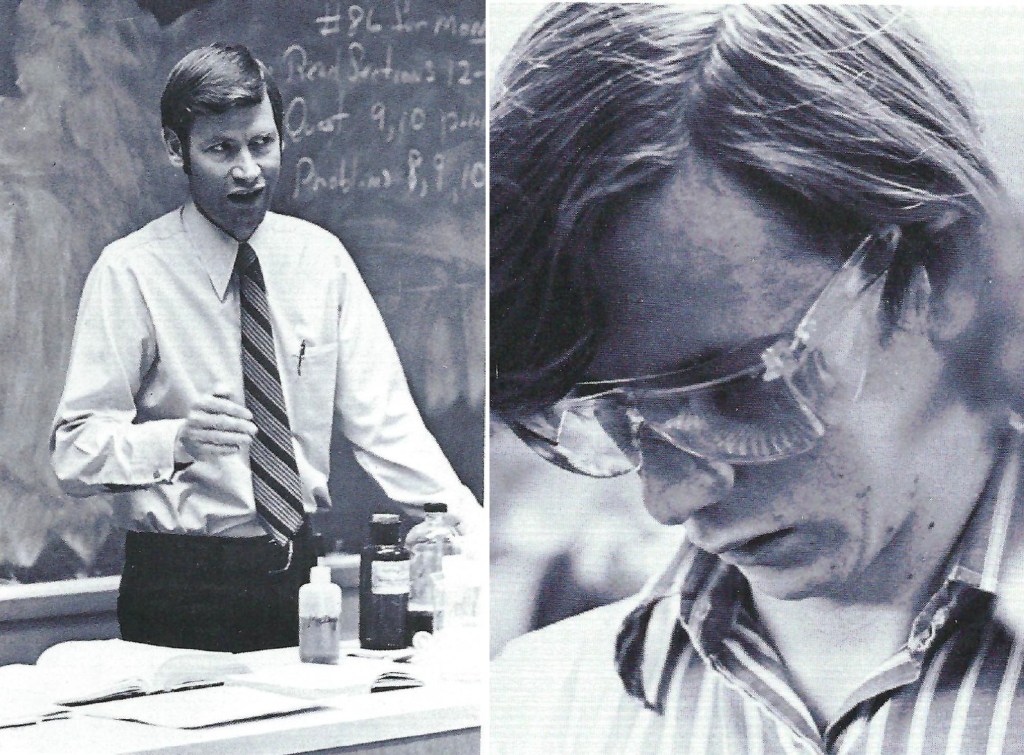
I credit this aberrant (for me) behavior to my chemistry teacher, Fred White, who died this month at 92.  New to my school at that time, he was kind, quirky, and fun, and he made his subject so interesting I didn’t want class to end … so I kept at it on my own time.  He explained in simple terms why carbonated beverages exude gas when shaken (H2CO3 + energy = H2O + CO2) and excited me with edgy (dangerous?) experiments like the beating heart and generating phosphine, which ignites spontaneously upon exposure to oxygen.  The more I learned the more I wanted to know … a hallmark of a great teacher.

Since entering middle school my goal had been to do just well enough to stay off everyone’s radar, but my fascination with chemistry was creating a problem.  I came into class one day to find my name on the corner of the blackboard, along two others at the top of my grade.  I asked Mr. White why my name was up there and he said, “recruiters from MIT are visiting, and they would like to meet with you.”  I asked, “Why me?” and he replied, “You might not have noticed, but you got an 800 on your chemistry SAT.”  He challenged me then and there to start thinking about myself differently.

I was far from the only student wanting to keep taking classes from Mr. White.  This being the early 1970s, he created a class on environmental science, introducing us to pivotal books like Silent Spring, which helped birth the environmental movement, and The Population Bomb—the latter serving as my first exposure in school to the topic of birth control.  He didn’t feed us these ideas as doctrine—he encouraged our full engagement but also challenged us to assess them critically.  Only now can I fully appreciate the subversive genius of this aw-shucks Midwesterner.

When my thoughts turned to college, Mr. White encouraged me to consider Reed, in Portland, OR.  Just before coming to my school, he’d received a grant from the National Science Foundation to obtain a Master’s degree from Oregon State University, which brought him into contact with students and faculty at Reed.  He said, “Boy, they are really bright—it seems like the kind of place you might fit in well.”  Helped, no doubt, by his letter of recommendation, I was admitted, and it is now my alma mater.

His caring went beyond the classroom.  A year after I graduated, I was home for a summer job, and I received a call from Fred (no longer Mr. White) out of the blue.  He said, “I’ve got a really neat new sailboat—I thought you and some of the others might enjoy taking it out with me.”  It was an afternoon I’ll never forget, not just for the good times shared but for reinforcing my still-fragile sense that I was a person a non-parental adult might care about, just for who I was.

Fred and I corresponded periodically as adults.  Upon the occasion of his retirement I wrote a letter to Fred telling him how much he had meant to me.  He responded with characteristic humility and humor.  “Such a satisfaction to know that one’s efforts were worthwhile in helping you toward a bright future … Those first few years at PHS covered the spectrum from agony to ecstasy … all awkwardness and broken glass.  We poisoned ourselves with regularity and relish.  My moderate liquor bill became more significant!  But we did have a good time and learned some good science.

In 2001 I sent Fred a copy of Uncle Tungsten: Memories of a Chemical Childhood, by Oliver Sacks, and he responded quickly.  Beyond their shared passion for chemistry, Fred noted that he and Sacks were both born in 1933 and shared many memories of a boyhood growing up in the shadows of World War II—including collecting cans and newspapers for the war effort—albeit from opposite sides of the Atlantic.  Our correspondence opened up for me a whole new dimension of this marvelous and complex man.

Now Mr. White is gone, joining the pantheon of those who shaped my life and now are but memories.   As a chaplain and friend, I often try to comfort those grieving loss by offering wishes that the memories of their loved one provide them with solace.  There is a traditional Jewish saying—”May their memory be a blessing to you”—that captures this succinctly.  Even better is sharing memories with others grieving the same loss.  It’s why my favorite memorial services are filled with stories of the one who has departed.  I have shared these memories with friends from those days who were similarly blessed by Mr. White, and I have listened to their stories in return, we have all been blessed in the process.

I think I can best sum up Mr. White’s impact on my life with a story … In 2000 I joined several community leaders to co-found a nonprofit called Oregon Mentors (now the Institute for Youth Success), dedicated to helping youth from all walks of life find supportive adults to help guide them toward adulthood.  During fundraising meetings or luncheons, we would ask those in our audience to think about a non-parental adult who’d made a big impact on who they are today.  We could count on the fact that, if they’d made it into one of those rooms, they almost certainly had such a person, and this immediately connected them to our mission.

Mr. White was always that person for me.  Who is it for you?  I’d love to hear your stories!

A Hero’s Farewell

My day began with a consult order for an ICU patient who’d just transitioned to “comfort measures only” (CMO)—no more curative treatments.  David, 52, was found down the night before in a home south of Portland.  Paramedics restored his heartbeat and breathing (with intubation), but tests at the hospital showed only minimal brain activity, as well as fentanyl and meth in his blood.  His only child, Isaiah, a young adult, was by law his surrogate decision-maker; together with David’s mother, Jean, and his brother, James, they concluded their only option was to let him die in comfort.

I enter David’s ICU room and introduce myself.  These three, plus other family members, turn to me with tears in their eyes.  Isaiah takes my outstretched hand, then pulls me into an embrace.

“Thank you so much for coming.  This means the world to us.”  I hold him as he weeps softly, then he hands me off to his grandmother, Jean.

“Thank you for being here,” she begins.  “It’s not supposed to be like this, I’m supposed to go first.  And I’ve already lost my only daughter.  James is all I have left now.”

James, who has been pacing, shouts “Come on, David—get up!” and then “I can’t take this anymore,” and leaves with his wife.  The room settles once again into somber quiet.

“I want to let you know I’m here for anything you need,” I begin.  “A listening ear, prayer, whatever.  I also want to offer you a comfort quilt.  They are made by volunteers for times like these; I like to say they have prayers sewn into each seam.  Do you think that’s something you’d like for David?”

They nod in unison.  “Definitely,” Isaiah affirms.

“Great, it’s so much more personal than a hospital sheet.  Did he have any favorite colors?”

Isaiah replies quickly.  “Red and gold.”  I raise my eyebrow and he continues.  “49ers, his favorite football team.”  All in the room smile and nod.

“OK, let me see what I can find.  I’ll be back shortly.”

The decision to transition to CMO is always difficult, especially when the patient can’t speak for themselves.  It is doubly difficult when the patient’s condition arises suddenly, as David’s did, and even more so when the family is divided (see What Would Dad Have Wanted?).  In this case, fortunately, the sense of family closeness and cohesion was palpable from the moment I stepped into the room.

Regardless of the situation, the offer of a comfort quilt is almost always soothing to loved ones, and most accept it.  It humanizes an otherwise sterile setting, and it allows those gathered to feel they are doing something for their loved one, shortly after they have surrendered hope that they can do anything at all.  I even once had a daughter say, “Mom used to participate in a quilting bee that made these … now it comes full circle.”  I am so grateful for this practice, and I welcome each opportunity to offer it.

Bearing a red and gold quilt, I find the family in the ICU waiting room, as the staff needed time to prepare David’s room and person to receive visitors saying their good-byes.  The group has grown to include Isaiah’s wife and his 10-week-old son, as well as Isaiah’s mother, Amy—once upon a time David’s wife.  They beckon me over, put a chair in the middle of their circle, admire the quilt, and give me their attention.

“It will be a few more minutes before we’ll be able to lay the quilt on David,” I begin.  “What would you like me to know about David that would help me be with you at this time?”

The responses are immediate, heartfelt, and often irreverent if not hilarious.  The universal sentiment, never spoken aloud, is that they want me to know David not for how he died, but for how he lived.

Isaiah starts.  “He worked in construction, worked harder than anyone I’ve ever known, and loved every minute.  He’d call to tell me he was on top of some tall building, or on the tarmac at the airport, and always say ‘Isn’t this just the coolest thing?’”

“You’d feel he was your friend 30 seconds after you met him,” said another.  “He knew everyone, I mean everyone.  You’d walk into a restaurant and he’d know the cooks and dishwashers.  He lit up the room.”

“His house was yours, and yours was his.  He’d come over, walk into your kitchen, open the fridge, and say ‘Whaddya got?’”

I ask if he ever got to meet Isaiah’s son.  Amy smiles and says, “He came over to my place just last month.  He walks in unannounced and says, ‘I’m here to meet my grandson.’  He was over the moon.”

“Did he open your fridge?” I ask.  “Of course!” she responds, and everyone laughs.

The time comes for me to lead the closest family members back to David’s room.  We gather around the bed, and Isaiah and Jean spread the quilt over David.  James pulls out a 49ers t-shirt and lays it on top of the quilt, over David’s chest.  The family has told me they are Christian, so we hold hands in a circle and I offer prayers in their tradition.

“Dear loving creator God, thank you so much for the gift of your son David.  Thank you for the way he brought your Light into the world and spread it among everyone he touched.  Thank you for blessing him with a child, and now a grandchild.  Help us to keep alive the spirit and warm memories he left us with. 

“But, God, right now all these hearts are torn apart and hurting.  You promise you are here when we gather in your name, so help us to feel your presence among us, bringing your deep comfort and peace, now and in the difficult days ahead.  We ask these things in the name of your son Jesus Christ.”

A short time later I consult with the nursing staff and then go out to meet with Amy, Isaiah’s mom, who has emerged as the go-to person for the unavoidable administrative details of this situation.

“I have a few things I need to go over,” I begin.  “The staff thought you might be the best person for me to talk with.” 

Amy nods.  “Isaiah is the decision-maker in the end, but I’m trying to take as much burden off him as I can.  He’s still young, and a new father, and David meant the world to him.”

I hand her our pamphlet What Do I Do Now?  “I know you haven’t had time to think about any of this, but it’s a great resource for all the things you’ll need to do, like selecting a funeral home and obtaining a death certificate.  Step 1 is to take care of yourselves—this can all wait a day or two.”

Amy lets loose a long sigh.  “I have been thinking about this, but I’ve had no idea where to begin.  This will be a big help.”

I pause, then continue.  “I also want to let you know that David is eligible for evaluation as an organ donor.  Is that something you think Isaiah and the family would want?”

Just then Isaiah joins us, and when I repeat this he is enthusiastic.  “My mom and I have actually talked about it, and we’d like to do it.  My dad always looked up to heroes, wanted to be a hero, wanted to save others, and this would let him go out a hero.  We absolutely want this—for him, and for us.”

One of the many things I love about my hospital is that we are a center for organ donation, as well as kidney and cornea transplantation.  It’s always heart-wrenching to see organ donors on the ICU census, whether from our hospital or transferred from another, as they’re usually on the young side—younger than David—and most have died sudden deaths, like overdoses or motor vehicle accidents.  No matter the location or circumstances of their death, we always try to treat donors and their families with compassion and respect.

In particular, whenever possible, we conduct a ritual called an honor walk (or hero walk), “a ceremonial event to commemorate a patient whose organs are donated.”  Family and loved ones are invited to join hospital staff to line the hallway from the patient’s room to the elevator leading down to the OR suite, where the organs are removed and and life support is discontinued.  It is a solemn and moving ritual, offering the family some positive closure to an otherwise tragic death.

The following evening I enter the ICU waiting room 15 minutes before David’s honor walk and I’m stunned to encounter at least 25 family members and friends, most decked out in 49ers jerseys, scarves, or other swag.  Isaiah, draped in a 49ers flag, strides over to greet me and wraps me in his arms, flag and all.

I greet the family members I know, and meet others I don’t.  Friends, co-workers, in-laws, the whole gamut.  There is some light banter—Seahawks fans grumbling about wearing 49ers gear—but the love in the room is overwhelming.  The sadness is overwhelming, too, especially for David’s mom Jean, but she is strong and supported by the most important people in her life.

Soon it is time.  I lead everyone in and help them line the path David’s gurney will take.  Isaiah, Jean, James, and Amy join the care team in David’s room, then walk alongside his gurney as it traverses the path to the elevator lobby.  After many hugs, family and friends head off into the night.  I stay with Isaiah, Jean, and Amy; along with two nurses from the organ donation program, we wait for the elevator to arrive.

Isaiah reaches for one last hug.  “You’ve been with us from the beginning, I’m so grateful you could be here tonight, when we get to make Dad a hero.”  The others share similar sentiments, and all I can say is that the blessing is mine to accompany a family with so much love.

The elevator arrives and the nurses lead them in, along with David’s gurney.  The doors close behind them, taking them on their hero’s final journey.

When Do I Get My Needs Met?

Among several patients on the oncology unit in need of a chaplain visit, one stood out:  Helen, a woman in her 60s whose breast cancer had been kept in check for several years, had a new large mass in her lungs—and she was the sole caregiver for her husband, who had advanced bladder cancer.  The hospital staff were concerned about her emotional state, and hoped she might open up to a chaplain.

“Good morning, Helen, my name is Greg.  I’m one of the chaplains here.  I’m making rounds to check in on folks.  I understand you’ve gotten some difficult news.”  She turns and glowers at me silently.  “You don’t owe me anything,” I continue, “I just want to offer to be a listening ear if you’d find that helpful.”

After a moment she says, “I just want to die.”

“That sounds like a really hard place.  Thank you for sharing that with me.”

“I really mean it—that’s what I want.”  I nod and wait.  “Years ago I was a caregiver to my grandparents as they went through a long decline.  Not long after, I went through the same thing with my parents.”  She pauses, then continues, with rising fury.  “Now I’ve been the sole caregiver for my husband for several years, all while dealing with my own cancer.  What I want to know is:  When do I get my needs met?”

Helen catches her breath, then answers her own question.  “Dying—that’s how I get my needs met.  Everyone thinks I’m upset because I have this big new tumor, but that’s not it.  I’m not going to treat it, because it’s my ticket out of here.  I will finally get some rest.”

As extreme as Helen’s solution seems, I can’t say it shocks me.  I encounter caregiver burnout—“a state of emotional, physical, and mental exhaustion caused by the prolonged stress of caregiving”[1]—all the time, at the hospital and in my personal life.  Chances are that you, or people you know well, have experienced it, too.

A chaplain’s work in a hospital (or in hospice) frequently focuses less on the patient than on their loved ones, especially if the patient has been in declining health for months or years.  During quiet times, when the patient is sleeping, or in an encounter in a waiting room or hallway, loved ones open up about their experience of caregiving, and their stories can be heart-rending.  Sympathies flow naturally to the one suffering illness, while those who care for them can feel invisible and unappreciated.  But the spiritual suffering of the caregiver can be every bit as painful as that of the patient.

The situation is yet more difficult when the relationship between patient and caregiver is strained.  I visited with a woman in her 30s who moved to Portland four years ago to attend to her mother’s deteriorating physical and mental health.  Every day at the hospital, she sat bedside while her mother ranted and made demands.  When she finally got a moment to speak privately, she shared that she’d never had a chance to make friends since moving, that caring for her mother had consumed her life.  We gave her some ideas for resources that might help, and she smiled.  “Anything is appreciated!”  Fortunately, plugging “caregiver burnout” into a search engine will yield resources that offer support—and relieve the sense that one is alone in this struggle.

I was moved recently by a post in a Substack I follow (Life Isn’t Fair, in The Corners by Nadia Bolz-Weber), wherein a reader asked, “How do I remain a compassionate caregiver for my 89 year old mother who never once cared for me when I was ill, or broken-hearted, or bereft?  How do I do this while getting older myself?  Where is God in all this?”  The story sounded familiar, and indeed it was from a friend and past contributor to Elder Chaplain, Elissa Altman.[2]  I reached out to Elissa, and we corresponded further; Elissa’s sharing of her own “sheer exhaustion, confusion, and desperation” helps me better understand the experience of my patient Helen and other caregivers. 

Even in the best of situations, when patient and caregiver have a loving, mutually respectful relationship and the support of friends, the toll of caregiving can be steep.  Caryl and Jeff, whose story is included in the post Here For Each Other, have been living through Caryl’s journey with Parkinson’s since 2013, and Caryl’s needs for help from Jeff are only growing.  In the recent post Choosing Life, One Day at a Time, about living with advanced ALS, Lynette acknowledges that Bruce’s death will serve as a “release” from the sacrifices she has made in caring for Bruce.  “Release” is what I hear Helen seeking, too.

Where is God in all this? 

I found glimmers in Nadia’s reply to Elissa’s question, though whether it’s satisfying depends on one’s own beliefs.  As I hear Nadia, “grace” is that extra gift we receive that elevates us from what any human could do on their own “if left to bootstraps and good character,” to who we are today.  In Nadia’s view, she (and Elissa) are in better places now than they had any reason to expect, given the circumstances of their birth and life.  She urges Elissa to find a way to lean into that grace to carry her through the final stages of her mother’s life—and her own.  As the hymn Amazing Grace proclaims, “Tis grace has brought me safe thus far, and grace will lead me home.

This actually fits pretty well with my own theology.  I don’t believe God wills suffering for any of us, but suffering is nonetheless an unavoidable part of human existence.  The Christian gospels speak to me because they express God’s profound desire for us to know healing and peace, no matter how deep our suffering or whatever responsibility we bear for it.  I have personally experienced God’s grace and healing Spirit, not only in my inner being but also in the good things that have happened to me that I can’t claim credit for, especially the people who have come into my life and loved me and cared for me.  This has sustained me thus far, and I have faith it will continue to do so. 

All I have seen
teaches me to trust my creator
for all I have yet to see.

At the end of our time together, Helen, a Christian, asks for prayer.  She has not changed her mind about declining curative treatment, and it’s not a chaplain’s job to seek or even hope she will do so.  I simply lift her up as she is.

“Dear loving Creator God, thank you for the gift of your child Helen.  Thank you for giving her the heart, the strength, and the skills to care for so many people in need.  Now she is in her own time of need, and you have heard her share deeply and honestly from her heart.  Help her to feel your love and your care for her today, and to feel your presence and guidance as she seeks her way forward.  Help her to know of your unconditional love and care for her, her husband, and her loved ones no matter how her situation unfolds.  Please remain by her side all the rest of her days.  Amen.”


[1] Understanding Caregiver Burnout and Compassion Fatigue, Caregiver Action Network

[2] Inside The Waiting, Elder Chaplain

Three Score and Ten

In the Irish writer Claire Keegan’s gorgeous short story Foster, a family on their way to a wake stop to speak to two farm hands walking by the road, and share where they are going.

“God rest him.  Didn’t he go quick in the end?” one man says.

“Aye,” says the other.  “But didn’t he reach his three score and ten?  What more can any of us hope for?”

As I will reach my three score and ten before the end of July, this exchange has special resonance for me.  The second farm hand poses a fair question.

When I share the news of my upcoming birthday with acquaintances, I get two types of responses.  The first, usually from someone younger, is to compliment my appearance and fitness.  I have definitely been blessed—by genes, self-care, and providence—to arrive at this birthday with reasonably full command of my body and mind.  I thank modern medicine, too, as I dodged a near-fatal illness in adolescence and two incidences of cancer in middle age, as well as a hip replacement without which I would have much less mobility.  So I’m grateful to be here, such as I am, and if this gives my younger friends encouragement, so much the better.

The second, always from someone older, is “Such a youngster!”  The implication of this comment, as I see it, is that I’m just starting to glimpse what lies ahead in the deterioration of body and mind.  And it’s true.  Despite the health issues noted above, and increasing daily aches and pains, I’ve not endured chemo or heart procedures, nor been diagnosed with incurable cancer or a progressive or debilitating illness like Parkinson’s or ALS.  But close friends my age have, and I may well too.  My father lived with Parkinson’s for 17 years, the last five with progressive dementia.  I’ve long assumed that, if nothing else takes me first, this may be the path I follow.  In my head, at least, I’m OK with this.

What more can any of us who reach three score and ten hope for?  Of course, we can hope to live into our nineties, relatively free of disease and infirmities, and then pass peacefully in our sleep.  I have friends and family members who’ve gone down this path, too, and a beloved friend has arrived there and is ready to go any day.  But can I expect this, in the sense that anything less will be a denial of my entitlement?  To me, doing so feels like a setup for disappointment.

Growing old becomes clear to you at a certain point.  I think it’s after the age of 70 you realize—you begin to actually be convinced—you’re growing older.

Leonard Cohen

Perhaps this is what my older friends are referring to when they say “Such a youngster!”  They can see I’m not yet fully convinced, in the way they have become—that I lack the wisdom they have gained, that I haven’t lived it enough to fully own it.  They are right, but as I see it the only thing I can do is continue to live mindfully in this body of mine and see what comes my way.  The one thing I can count on is that something will, indeed, come my way.

Seventy years is the span of our life,
eighty if our strength holds;

So make us know how few are our days,
that our minds may learn wisdom.

Psalm 90, vv. 10, 12

What we can hope for, I think, is to learn wisdom.  For me, this is inseparable from embracing the knowledge that my days are few—far fewer than I have already enjoyed.  One of my reasons for pursuing and practicing chaplaincy is to get better at this embrace, so that I’m able to accept whatever fate comes my way—whenever it comes—with courage and grace.  Many of the patients, family members, and friends I have written about in Elder Chaplain posts have exhibited this wisdom, and they have taught me much and inspired me to no end.  For this, I am deeply thankful, and I look forward to learning more.

There is a road, no simple highway
Between the dawn and the dark of night
And if you go, no one may follow
That path is for your steps alone

If I knew the way I would take you home

Ripple, The Grateful Dead

For all I have learned from patients and friends, though, these are other people’s lives, and other people’s stories of grappling with the finiteness of their days.  My path is mine alone to walk, just as their’s is their’s alone.  We can’t walk in each other’s footsteps, but we can walk alongside each other, sharing with each other what we see, feel, and experience.  None of us knows the way, but I find comfort in having the company of others as we seek our way forward.

So as I reach seventy, I can hope that my strength holds to eighty or more, but more important to me is knowing I don’t have to do it alone.  To know I can share my hopes and my fears of the unknown with others, and listen to their hopes and fears.  It’s taken me most of my three score and ten to acquire this wisdom, and I still have much to learn.  But if I use whatever remaining days I’m granted to keep growing in this wisdom, I hope to have little to fear.

Choosing Life, One Day at a Time

I first met Bruce in August 2014 in a parking lot near the base of Mt. Baker, a 10,781’ glacier-covered volcano just south of the Canadian border in northwest Washington.  Bruce, his wife Lynette, and I were part of a group of six climbers, plus two guides, setting out on a 3-day trip to summit the mountain.  A group like this needs to form high-functioning relationships in a heartbeat, and we did.  It was one of the most memorable outdoor experiences of my life, and the friendships from that trip have endured.

Unfortunately, in March 2021 Bruce was diagnosed with ALS, and the disease has slowly but steadily chipped away at his physical capacity ever since.  An avid skier, hiker, and climber, Bruce had to cease these at once, since vigorous exercise accelerates the weakening of muscle tissue.  For a time, a motorized scooter allowed Bruce to enjoy smooth trails and visit with friends at the trailheads of the Climb for Clean Air hikes in which he used to participate.  He became an avid promoter of Ski ALS—that’s Bruce riding a sit-ski in the picture above—to support the organization that has served Lynette and him so well.  2024 was the last year for riding the sit-ski, though Bruce still actively promotes this cause.

Bruce now spends his daytime hours in a high-tech motorized wheelchair.  He is completely dependent on others, mostly Lynette, for all activities of daily living.  When three of us visited Bruce and Lynette in their new home this past November, it was difficult to see his dramatic physical decline, but his spirit remained strong.  While eating lunch, Bruce asked for more chips and hummus.  Seated next to him, I asked if he would like assistance, and he replied, “We’ll see.”  With one hand he scooped hummus onto a chip, then, with support from his other hand, he raised it to his mouth and ate it.  He turned to me and smiled, saying “These days, it’s all about the little victories.”

I asked Bruce then about his prognosis, and he responded, “They’re telling me 3 to 6 months.  My goal at this point is to hold my second grandchild, who is due in February.”  Following this visit, I proposed—and he agreed—that we engage in a dialog I called “Hard Earned Wisdom,” an open conversation regarding his experience with ALS and the insights and realizations this has afforded him.  No one would choose this path to wisdom, but as Bruce has no choice in the matter, we thought it would be interesting to see what surfaced.  Bruce is a consummate teacher, and the opportunity to be of service to others was motivating to him.

Of course, when it comes to wisdom “there is nothing new under the sun,”[1] but each of us must acquire wisdom in our own way.  For Bruce, learning and practicing patience has been of central importance.  Everything takes much longer—nowadays a shower is a multi-hour affair.  ALS has also strengthened his muscles of gratitude—as he grew increasingly less able to do things for himself, he became even more profoundly appreciative of all that others—especially Lynette—contribute to make his life possible.

Bruce has found it unexpectedly difficult let go of activities and interests when it becomes clear he can no longer to do them, especially his passion for outdoor activities.  A gifted astronomical photographer, Bruce built a nice amateur observatory in their former home, and he kept at this for quite a while.  But he and Lynette decided they needed to leave that home to move closer to family, and to a home better suited to Bruce’s needs.  He now accepts that his former home, with its mountain views and observatory, is in the past, too.

When Bruce and Lynette received his diagnosis in 2021, Bruce said he felt numb, while Lynette said she went into “fight or flight” mode.  Both soon realized the importance of staying in the moment, taking each day as it comes.  This was hard at first, with ALS providers urging them to make decisions about future care, but most of that is behind them now.  Still, day-to-day living remains difficult, and is only growing more so.

I have written before about “transforming hope,” and Bruce has become a master at it.  In November the goal of holding his new grandchild was realistic and motivating, and in February it joyously came to pass.  Afterwards I asked if he had any new “hope goals,” and he told me he was hoping to attend the annual awards banquet for the Crystal Mountain Ski Patrol in late May, where he was to be recognized.  Ski Patrol was central to Bruce and Lynette’s early relationship, and friends from those days have upheld them on their journey with ALS.  This event, too, has come to pass, and they had a wonderful time.

A vignette from that banquet has stuck with me, as it speaks volumes about who Bruce is.  Whe he last attended this event, not long after his ALS diagnosis, someone, noticing his limp, asked if he’d had a hip replacement.  “It’s a bit worse than that,” he replied with classic understatement.  This time, when asked to speak, he went up in his motorized wheelchair, drawing every other breath from his oxygen tube, and said, “May is ALS Awareness Month, so let me tell you a little bit about it.”  ALS is a horrible disease (as Bruce always describes it), but those suffering from it are no less human for it, and still desire to be seen, known, understood, and engaged with.  I’m sure no one left that event without this awareness (or a dry eye).  As I said, a consummate teacher.

I’ve always thought ALS provides a textbook case for medical aid in dying (sometimes called “death with dignity” or, less delicately, “assisted suicide”), and I still do.  There are no effective treatments for ALS, and it usually ends in suffocation, from losing the musculature that enables breathing.  Some with ALS choose to end their lives, and right after his diagnosis Bruce thought about it, too.  Lynette told him, “It’s up to you, I’ll support you whatever you decide.”  But his symptoms were relatively mild at first, making decisions about end of life feel less urgent.  Living in the state of Washington, he knows he has the option, but he has not made definitive plans one way or the other.

Much time now is spent preparing for the end.  Bruce barely survived a long stint in the ICU last summer, and he knows that “one day soon my lungs will do me in.”  He agonizes over the burden his care needs put on Lynette—it’s a full time job for her, and she can no longer come and go, even for a short period, without someone else to help.  When his needs increased greatly following the hospital stay, Lynette found herself saying, “We said for better or for worse, but this?”  ALS truly is a horrible disease, for the patient and for loved ones.

Bruce has begun planning for his memorial service, partly because he can and partly so Lynette doesn’t have to.  He reflects, “While it’s not like I want my life to end, I’m thinking of it more now like … ‘release’ is the word I use.  I’m not in bad pain, but I’m in pain and I can’t do just about anything for myself.  And it’s release for Lynette, too.”  Lynette agrees.  Exhausted and depleted as she is, though, she has kept her promise to support Bruce in whatever he decides, sustained by a strong circle of friends and her love for Bruce.  They have the same birthday, and recently enjoyed their 49th shared birthday celebration.

During a recent conversation, following the Ski Patrol event, I asked Bruce once again if he had a new “hope goal.”  After mentioning an upcoming visit from a relative, he pivoted and said:  “On a good day, we can take our dog Luna out for a walk in the neighborhood—Luna on the leash with Lynette, me in my wheelchair.  We’ve mapped out a circuit of maybe a mile that my wheelchair can handle, and one place has a nice view of Mt. Rainier.  A day like that is a day worth living for.”  Choosing life, one day at a time.


[1] Ecclesiastes 1:9

I Can’t Believe This Is Happening So Quickly

I received a call one morning from Jacob, a nurse on the oncology unit. He said Sue, a patient I’d built a warm rapport with during an earlier stay (Telling Our Life Stories), had just arrived back on the unit and was not doing well; Sue’s wife Andrea recalled my name and asked Jacob if I could visit.

I arrive and find Sue in distressing pain, with Jacob doing all he can to make her comfortable. Andrea, whom I’d never met, rushes over to greet me.

“I knew this day would come, but I can’t believe it’s happening so quickly.” She collapses into my arms, sobbing. All I can do is quietly acknowledge the truth: dying is hard, for patient and family, no matter how ready you think you are.

After a moment Andrea straightens up and announces brightly, “Sue, Chaplain Greg is here to see you. You remember how much you enjoyed your visits with him?”

I move bedside opposite Jacob, take Sue’s hand, and greet her warmly. But Sue is past the point where comforting words and touch can ease her distress.

“I feel like I’m burning up inside. I need pain meds NOW!” Sue struggles to get out of bed, and Andrea and I restrain her while Jacob administers pain and anxiety meds. Soon Sue’s struggling diminishes, and she lays back in bed.

Jacob begins to start IV lines and prepare Sue for her stay. Andrea reaches for another hug and repeats, “This is all just happening so quickly.” As Andrea’s sobs subside, I agree to return later in the day, once their children arrive.

Death sometimes arrives with no forewarning: a massive heart attack, a brain aneurysm, an accident. Past a certain age, though, we are more likely to die from conditions that progress relatively slowly: cancer, congestive heart failure, or simply old age. This is largely a blessing, I think, as it gives both the dying person and their loved ones time to prepare, and to share conversations that can be among the most intimate and meaningful of their lives.

But this blessing brings with it a challenge: navigating many difficult decisions around whether to pursue treatment(s) for the condition(s) or to cease curative care and let nature run its course, with treatments focused solely on comfort and quality of life. In my experience, there is no “right” way to do this—so many considerations are specific to each situation and individual.

Many factors influence patients in the direction of curative care, even when the odds seem small. First, of course, is our own desire to enjoy more time and postpone death, as well as our loved ones’ desire for us to continue living, postponing the loss they will suffer when we die. Our healthcare system is also incented toward curative care: doctors and other providers are trained to treat illnesses, after all, and they make their livings—and derive professional and personal fulfillment—from providing curative care, not discontinuing it. Our prevailing cultural narrative is one of “fighting” and “battling” illness, not “giving up hope” until the bitter end.

For some, this is the course they choose, and I can understand why. A family friend was diagnosed at age 87 with lymphoma and fought it tooth and nail, undergoing excruciating treatments against medical advice—and was rewarded with 6 more years of life, replete with weddings of grandchildren and births of great-grandchildren, dying suddenly while still pursuing an active life. This outcome was far from foreordained, however, and others facing the same circumstances might wish to choose differently.

Sue’s story is more representative of my experience as a chaplain, and in life. When first diagnosed with cancer, Sue pursued curative treatments that gave her several joyous years. When I first met her, she’d exhausted most options, but told me “there’s an immune therapy treatment I could try; it might make a difference, but even if it doesn’t, it could give me more time with my wife, children, and grandchildren.” A solid choice for her, I thought then. Unfortunately, it didn’t buy her the time she’d hoped for.

There’s a term we use on my chaplaincy team: transforming hope. Not giving up hope—life is meaningless without hope—but refocusing the goals one hopes for as circumstances evolve. Sue’s hope for more time didn’t seem unrealistic when we spoke, though I don’t know what prognoses her oncologist gave her regarding pursuing immune therapy vs. discontinuing curative care—or even whether a candid discussion of these alternatives took place. It can be so hard for patients, families, and providers to refocus goals of care even when the evidence suggests they might want to.

The result of failing to do so, though, can be a crisis like what Sue and her family experienced. Andrea shared with me that it had quickly become clear Sue’s immune therapy treatments weren’t working, but their hope did not evolve to align with this reality—until Sue’s crisis made such hope untenable. Instead of gradually transforming their hope, it all had to happen so quickly …

By afternoon Sue is resting comfortably. I gather with Andrea, their sons, and an adult grandchild—a lovely family wanting only the best for Sue. Andrea says she and Sue planned for her to die at home—in the not-so-near future. Now she wants to know my thoughts. I offer that, while dying at home is an ideal we often hope for, it can be stressful if the patient has high care needs, as Sue does. I watch Andrea flash back in her mind to the scene in Sue’s room earlier that day, then shudder at the thought of trying to manage this at home.

I continue, noting that the hospital setting frees family members from most caregiving activities, so they can focus on simply being present. Andrea quickly agrees, and the other family members breathe a sigh of relief—they will approve Sue’s transition to comfort care. They share a few warm reminiscences of Sue with me, then head off toward her room. Hope is transforming before my eyes …

Sue died peacefully just before dawn the following day, surrounded by her family.

In the End, Love

As a hospital chaplain, most of the patients I visit with return to the lives they have known, generally feeling much better than the day they arrived. It is a privilege to be with them at any stage of their journey: calming jitters before surgery, helping them find strength for healing and recovery, offering blessings for a safe transition home. It feels like an even greater privilege, though, to accompany patients and their families through their final passage in life.

One morning, as I built my patient list for the day, I noted that Frieda, a 93-year-old, had transitioned to “comfort care” and was expected to die in the hospital. As I approached the door to her room, her daughter, Janet, stepped out to refill her coffee from the cart outside. I introduced myself and let her know that chaplains were available if she wanted someone to be with. She nodded numbly and went back into the room.

An hour later I received a page informing me that Frieda had just died and Janet would like a chaplain to come to the room.

I arrive and find Frieda reclined in her bed, looking very peaceful. Janet is seated bedside, stroking her hand. I pull up a chair next to Janet; she extends her free hand to me, and I take it.

“I’m going to miss her so much,” Janet begins. “She was my best friend. We’ve talked every day for years.”

“That’s really hard, Janet. Sitting here, I can feel the love between you. What would you like me to know about Frieda?”

“She was a very simple person. She grew up poor and never had much use for money, but we always had what we needed. She lived on a few acres of land outside of town, gardening and keeping horses and goats, though lately she’s only had a cat.”

“Just looking at her, I can easily imagine everything you’ve told me. I’m sorry I never had a chance to know her.”

Janet tells me that the great heartbreak of Frieda’s life was losing a teenage daughter—Janet’s sister—in an auto accident many years ago. She says Frieda has made arrangements to be buried alongside her daughter. We talk for a few minutes more, then Janet asks if I can say a prayer.

“What can you tell me about Frieda’s faith or beliefs, so I can offer prayer in a way that honors her?”

“I don’t know, I guess Christian, though we never went to church and she never talked about it. But after we were grown up and she was living on her own, she started wearing this …”

Janet reaches out and cups in the palm of her hand a locket hanging around her mother’s neck. She presses on one side and it pops open, revealing a Christian cross inside.

“That seems like a pretty big hint as to what kind of prayer she’d appreciate,” I say, and Janet smiles. So I take Frieda’s hand, completing the circle, and offer a prayer of thanks for this beautiful child of God who brought so much light into the world in her 93 years.

Later that day I greet William, a seriously ill 80-year-old moved to the ICU after a Code Blue earlier in the week. His status remains “Full Code,” so the staff will attempt to resuscitate him if his heart stops again. William is intubated but alert; he greets me with his eyes but cannot speak. A somewhat younger woman is seated beside him; she confirms she is Beverly, his wife. She thanks me for coming but says she has no needs at the time, so I depart.

Near the end of the day I take one more pass through the ICU, and I note William’s status has changed to “DNAR”—do not attempt resuscitation. As I am leaving the unit I run into Beverly in the hall.

“I’m sorry I was short with you earlier. Your colleague was so kind and helpful to me after Bill’s Code. I just wanted to tell you I appreciate your work. I’ve been in and out of hospitals with William for six years now.”

“Six years … he must be a pretty special guy,” I say with a smile. Beverly turns to face me directly.

“I’ve been married three times, and I will tell you that William is without a doubt the kindest, most loving man I have ever known. When we met, he took on my four children as if they were his own, and they love him to this day as if he were their father.”

“How many years have you been together, Beverly?”

“Thirty-seven years now, and I have loved every minute.”

I extended my hand and she took it. “That’s something very much worth celebrating. I’m happy for you that you have known such joy. What a gift!”

Beverly pulled herself into my chest and sobbed gently as I held her. “It’s so hard to come to the end, but you’re right, I have been blessed.”

Beverly then stood back, straightened herself up, and said “Well, I must head back. Thanks again for caring and listening.”

I have heard it said that when a person dies, the thin veil between this world and the next parts briefly so they can pass through to the other side. While this notion doesn’t work for me theologically, I can’t deny that as a metaphor this resonates for me.

It is my experience that there is often an extraordinary quality to the time surrounding a death, when the light and love at the core of a person’s being comes to the forefront and is beheld by all present. That’s not to diminish the sadness of a person’s death, or to deny the complex, sometimes contradictory emotions we often feel toward a loved one. It’s just that these feelings often recede in the moment, leaving us filled with awe and gratitude for that person’s life and for the gifts they bestowed upon us.

My work as a chaplain is to help grieving people notice this phenomenon when it occurs, and to offer them space to give voice to what they see and feel as they accompany a loved one through death. I don’t feel what they feel, as these are not my loved ones, but I am blessed to bear witness to the love in the room, to share in the light pouring through from the parting of the veil. It fills me with hope for all I have yet to see for myself.

Damon

My pager buzzed: “The patient in 757 wants to see a chaplain ASAP.” Damon, in his early 20s, is undergoing withdrawal from multiple street drugs. A nursing note, just posted, says he got a distressing call and now wants to leave AMA (against medical advice) to go OD and kill himself. Deep breath …

I find Damon sitting cross-legged on his bed, a nurse seated beside him. She looks at me with relief; I take her seat and she departs. Damon glances at me through disheveled hair.

“Greetings, Damon. I heard you wanted to speak to me. I’m here to listen.”

“Yeah. I heard you might have an iPad I can use. I need something to distract myself. I just found out that my girlfriend—ex-girlfriend, now—has taken my phone and money and disappeared.”

“I’m sorry, Damon—that’s rough. We have two iPads people use to attend online 12-step meetings or worship services. I can see if one is available.”

Just then a lab tech comes in to draw blood. Damon asks me to stay.

“Can I find out my blood type from this test?” he asks the tech. She says no, not unless there’s a reason to run that specific test.

“If you donate blood at the Red Cross you find out automatically,” I blurt out before catching myself, “… provided you pass their screening checks.”

“I’ve donated before, when I’ve been clean. It makes me feel good to help someone who needs it.”

The lab tech leaves, but this exchange has broken the ice.

“Everything is just so shitty right now,” he begins. “I’d been doing OK—stayed clean for nine months, got off the streets and into transitional housing. My girlfriend—ex-girlfriend—helped me stay clean, but then my mom died and I relapsed, and she dumped me and took my things. Now I have nothing.”

“That’s a ton of hard stuff coming at you all at once—no wonder you’re upset.”

“I just don’t know where to go from here.”

“Are there other people in your life who are helpful to you?”

Damon launches into his life story, filled with loss at every turn. Born to an alcoholic mother, removed from her custody soon after by his father, a recovering IV drug user. Taken to be raised by his father’s parents, who were abusive and forbade him to speak of his mother. Lost his father to Hepatitis C in his early teens. Moved to Portland when he graduated high school, fell into drug use and homelessness. Sought out and reunited with his mother in Ohio, who’d gotten sober and remarried but had never stopped looking for Damon. Inspired by his mom he got clean but then she died and his world fell apart.

“Now it’s just my stepdad, but he’s dealing with his own grief from my mom dying, and we’re struggling to get along. So, really, nobody.”

At the time of this encounter I’d been reading Demon Copperhead, the prize-winning novel by Barbara Kingsolver. It is closely patterned on Charles Dickens’s David Copperfield, but set in a world she knows well: contemporary Appalachia. I couldn’t help noting the similarities between my patient’s tale and that of Damon, the protagonist of Demon Copperhead, so I chose that as my patient’s pseudonym. Whether in 19th century England or 21st century America, these stories are all too common.

The moral challenge posed by patients like Damon is “What is my responsibility to help?” It’s the question each of us faces when we encounter people on the streets suffering from mental illness, substance use, and/or homelessness—or simply driving past tents by the side of the road. This question must have tormented Kingsolver as well as Dickens—David Copperfield was semi-autobiographical. Their response was to write these novels, perhaps hoping that enlightening readers to the conditions they experienced might open their hearts and spur them to support social reforms.

I don’t have a good answer to this question for myself. I have no illusion I can solve the problems on the streets of Portland, any more than these novels could fix the places in which they were set. At the most basic level, I simply try to encounter people where they are, in their full humanity, as fellow children of God. It often scares the shit out of me—“Deep breath …” in my first paragraph is an understatement—but I’m usually rewarded by the person transcending any stereotype I may have formed in my head.

I don’t think this question will ever stop challenging me, and I hope it doesn’t. The calling to “comfort the afflicted and afflict the comfortable” resonates deeply for me. It forces me to acknowledge my own comforts and it spurs me to comfort others any way I can. I don’t have the gift to write great novels, so I do this. All that most of us can do is try to enlarge our comfort zones bit by bit to encompass an ever-larger swath of humanity. They all need what we can offer—and we need what they can offer us.

Damon and I talk about places where he might be able to build supportive relationships. He says there are a couple of good people in his transitional housing situation that he might be able to look to for peer support. We also talk about work.

“It’s so frustrating. I’m getting interviews, even second interviews, but still nothing. I’m a good worker and I have a good resume. I’ve just got to keep trying.”

I offer words of encouragement without minimizing the difficulty of the place in which he finds himself.

“Don’t worry,” he responds, “I haven’t given up hope. I know what that looks like, I’ve seen it in people on the street. You just look in their eyes and see there’s nothing there, they’ve given up. That’s not me.”

As I write this I still haven’t finished reading Kingsolver’s novel, so I don’t know how things work out for Demon Copperhead. I don’t know how things will work out for Damon, either. I do know that, when I saw him, he was being kept safe and was receiving medical and psychiatric care as well as social services, so that encourages me. When our eyes met before parting, I saw a determination, however fragile, to get better, to do better, and to serve others like himself.

I’d like to think my conversation with Damon helped him pull back from despair to a place where he could get better and emerge stronger. I don’t know that, though, and the odds are against him. I feel the same way about so many patients I see. But, as Damon said, I haven’t given up hope—that’s not me.