
Among several patients on the oncology unit in need of a chaplain visit, one stood out: Helen, a woman in her 60s whose breast cancer had been kept in check for several years, had a new large mass in her lungs—and she was the sole caregiver for her husband, who had advanced bladder cancer. The hospital staff were concerned about her emotional state, and hoped she might open up to a chaplain.
“Good morning, Helen, my name is Greg. I’m one of the chaplains here. I’m making rounds to check in on folks. I understand you’ve gotten some difficult news.” She turns and glowers at me silently. “You don’t owe me anything,” I continue, “I just want to offer to be a listening ear if you’d find that helpful.”
After a moment she says, “I just want to die.”
“That sounds like a really hard place. Thank you for sharing that with me.”
“I really mean it—that’s what I want.” I nod and wait. “Years ago I was a caregiver to my grandparents as they went through a long decline. Not long after, I went through the same thing with my parents.” She pauses, then continues, with rising fury. “Now I’ve been the sole caregiver for my husband for several years, all while dealing with my own cancer. What I want to know is: When do I get my needs met?”
Helen catches her breath, then answers her own question. “Dying—that’s how I get my needs met. Everyone thinks I’m upset because I have this big new tumor, but that’s not it. I’m not going to treat it, because it’s my ticket out of here. I will finally get some rest.”
◊
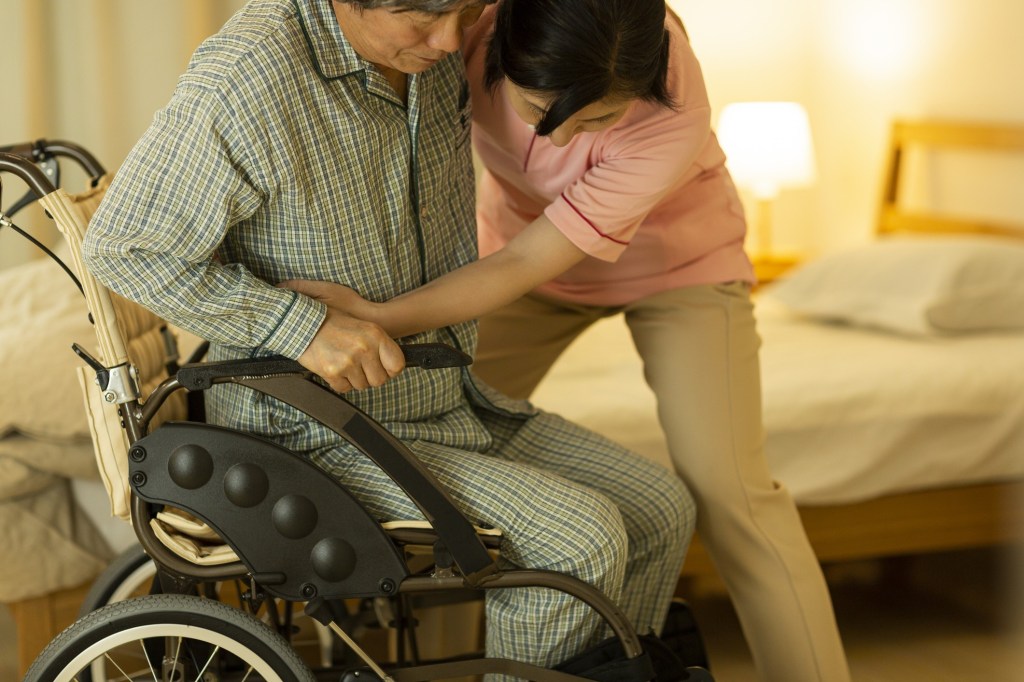
As extreme as Helen’s solution seems, I can’t say it shocks me. I encounter caregiver burnout—“a state of emotional, physical, and mental exhaustion caused by the prolonged stress of caregiving”[1]—all the time, at the hospital and in my personal life. Chances are that you, or people you know well, have experienced it, too.
A chaplain’s work in a hospital (or in hospice) frequently focuses less on the patient than on their loved ones, especially if the patient has been in declining health for months or years. During quiet times, when the patient is sleeping, or in an encounter in a waiting room or hallway, loved ones open up about their experience of caregiving, and their stories can be heart-rending. Sympathies flow naturally to the one suffering illness, while those who care for them can feel invisible and unappreciated. But the spiritual suffering of the caregiver can be every bit as painful as that of the patient.
The situation is yet more difficult when the relationship between patient and caregiver is strained. I visited with a woman in her 30s who moved to Portland four years ago to attend to her mother’s deteriorating physical and mental health. Every day at the hospital, she sat bedside while her mother ranted and made demands. When she finally got a moment to speak privately, she shared that she’d never had a chance to make friends since moving, that caring for her mother had consumed her life. We gave her some ideas for resources that might help, and she smiled. “Anything is appreciated!” Fortunately, plugging “caregiver burnout” into a search engine will yield resources that offer support—and relieve the sense that one is alone in this struggle.
I was moved recently by a post in a Substack I follow (Life Isn’t Fair, in The Corners by Nadia Bolz-Weber), wherein a reader asked, “How do I remain a compassionate caregiver for my 89 year old mother who never once cared for me when I was ill, or broken-hearted, or bereft? How do I do this while getting older myself? Where is God in all this?” The story sounded familiar, and indeed it was from a friend and past contributor to Elder Chaplain, Elissa Altman.[2] I reached out to Elissa, and we corresponded further; Elissa’s sharing of her own “sheer exhaustion, confusion, and desperation” helps me better understand the experience of my patient Helen and other caregivers.
Even in the best of situations, when patient and caregiver have a loving, mutually respectful relationship and the support of friends, the toll of caregiving can be steep. Caryl and Jeff, whose story is included in the post Here For Each Other, have been living through Caryl’s journey with Parkinson’s since 2013, and Caryl’s needs for help from Jeff are only growing. In the recent post Choosing Life, One Day at a Time, about living with advanced ALS, Lynette acknowledges that Bruce’s death will serve as a “release” from the sacrifices she has made in caring for Bruce. “Release” is what I hear Helen seeking, too.
◊
Where is God in all this?
I found glimmers in Nadia’s reply to Elissa’s question, though whether it’s satisfying depends on one’s own beliefs. As I hear Nadia, “grace” is that extra gift we receive that elevates us from what any human could do on their own “if left to bootstraps and good character,” to who we are today. In Nadia’s view, she (and Elissa) are in better places now than they had any reason to expect, given the circumstances of their birth and life. She urges Elissa to find a way to lean into that grace to carry her through the final stages of her mother’s life—and her own. As the hymn Amazing Grace proclaims, “Tis grace has brought me safe thus far, and grace will lead me home.”
This actually fits pretty well with my own theology. I don’t believe God wills suffering for any of us, but suffering is nonetheless an unavoidable part of human existence. The Christian gospels speak to me because they express God’s profound desire for us to know healing and peace, no matter how deep our suffering or whatever responsibility we bear for it. I have personally experienced God’s grace and healing Spirit, not only in my inner being but also in the good things that have happened to me that I can’t claim credit for, especially the people who have come into my life and loved me and cared for me. This has sustained me thus far, and I have faith it will continue to do so.
All I have seen
teaches me to trust my creator
for all I have yet to see.
◊
At the end of our time together, Helen, a Christian, asks for prayer. She has not changed her mind about declining curative treatment, and it’s not a chaplain’s job to seek or even hope she will do so. I simply lift her up as she is.
“Dear loving Creator God, thank you for the gift of your child Helen. Thank you for giving her the heart, the strength, and the skills to care for so many people in need. Now she is in her own time of need, and you have heard her share deeply and honestly from her heart. Help her to feel your love and your care for her today, and to feel your presence and guidance as she seeks her way forward. Help her to know of your unconditional love and care for her, her husband, and her loved ones no matter how her situation unfolds. Please remain by her side all the rest of her days. Amen.”
[1] Understanding Caregiver Burnout and Compassion Fatigue, Caregiver Action Network
[2] Inside The Waiting, Elder Chaplain
 Elder Chaplain