
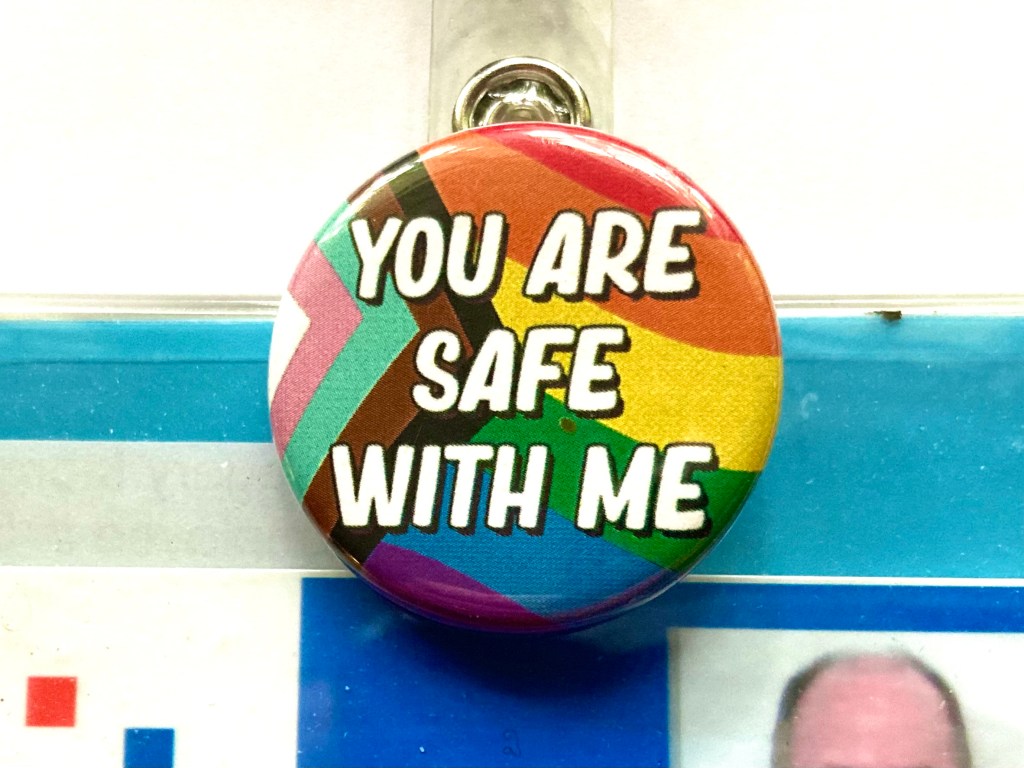
A couple of years ago, during Pride Month, someone at our hospital offered the button pictured above to anyone who wanted one. I have worn mine on my badge every day since, as “You are safe with me” is an appropriate message in any situation. Two recent patient encounters drove this home for me.
◊
Evan was a 32-year-old living on the streets, using fentanyl daily. A wound on his hand became infected; without care that infection grew into an abscess heading up his arm. Unable to bear the pain any longer, he came to our ER and was admitted for antibiotic treatment and surgery. When his nurse asked him if he would like to see a chaplain, he said he would.
I entered Evan’s room and found him in a fetal tuck, the sheets pulled over his head. When I announced myself, he peeled the covers back just enough to eye me, revealing close-cropped rainbow-colored hair. He motioned for me to sit on the foot of his bed, so I did. I told Evan I’d be happy to listen to anything he wanted to say, or just sit with him in silence. He responded, “Silence,” so I closed my eyes and sat silently. From time to time I looked over to him; often his eyes were closed; sometimes he was observing me, and I tried to offer an affirming smile.
After a few minutes I said, “I am also happy to offer a hand to hold, if that is something you’d like, but it’s completely up to you.” Quickly a hand slipped out from the covers, still stained from the grime of the street despite a hospital cleansing. I placed his hand in mine. His grip was initially limp, but soon he began squeezing gently, and I squeezed in response.
Then Evan spoke. “I just want to be healed from my addictions. Will you pray for me?” I asked, “Is there a religious tradition that is important to you?” and he replied, “Methodist.” I asked, “Were you raised in that church?” and he nodded yes; I asked, “Was that a good place for you?” and he nodded again; I asked, “Is that someplace you would like to move back toward?” and he nodded a third time. So I offered prayers using Christian language, giving voice to his pain and longings.
◊
As I shared in my previous post, Not That Kind of Chaplain, one of the central elements of creating a safe space is giving the other person maximum agency to set the terms of the encounter. For Ingrid, the patient at the center of that story, this was easy. But patients like Evan generally bring to the encounter a history of trauma, and life on the streets means having no safe spaces. Any attempt to move the encounter forward more quickly than the other person is comfortable with is likely to backfire.
Maslow’s hierarchy of needs places safety second only to our physiological needs, and under duress it can jump to the top. Most of us, when meeting a person for the first time, hold our cards close to our chests, opening up only to the degree we perceive the other person to be safe. My own needs for safety were much on my mind when I entered Evan’s room, and approaching him the way I did served my needs as well as his. I’m grateful that we each found the other to be sufficiently safe for such a meaningful encounter.
◊
Angela, a mother of three and survivor of a suicide attempt a month earlier, was admitted for a terrifying constriction in her windpipe. After surgical treatment she was healing well. During my first two visits other family members were present. Angela projected an upbeat vibe, but always urged me to return.
On my third visit Angela was alone. She opened our conversation by saying, “I really like your button. I noticed it before and wanted to say something.”
I replied, “I like it too. One of the most important parts of my job is to make people feel safe to share what’s really on their hearts.”
With that opening, Angela proceeded to speak honestly about her suicide attempt and all that led up to it: a lifelong struggle with depression, the end of a long-term relationship, losing her home and moving into a trailer, troubles with her kids, a sense of hopelessness, and a bottle of pills too readily available. But like George Bailey in the movie It’s A Wonderful Life, the people who showed up and cared for Angela through this crisis gave her a renewed appreciation for the value of her life and her importance to so many people.
Then she said, “I feel like I’ve grown distant from God. I used to go to a Bible church that I liked a lot, but then a new pastor came in saying all kinds of hateful things about people who didn’t believe the same way he did. That didn’t seem at all like what Jesus was teaching, so I left. But now I don’t think about the good things Jesus taught any more. Could you pray for me?” And so we prayed together.
◊
“You are safe with me” has become an important personal mantra, concisely encapsulating the type of person I want to be in all my relationships. I still have to tend to my own personal boundaries, of course, and not every person is someone I can feel safe with. Pursuing this goal has been a journey of personal growth, one that began years ago in my personal and professional life, even if I couldn’t previously name it this way. Now that I can, it’s something I want to consciously keep getting better at.
 Elder Chaplain
Once again, Greg, your compassion and empathy are inspirational as well as practical, having the wisdom to keep healthy boundaries. So important when supporting others experiencing trauma and isolation.
Respectfully, Craig K
LikeLiked by 1 person